9388. Thromboxanes
Description and references
Compounds derived from prostaglandin endoperoxides that cause platelet aggregation, contraction of arteries and other biological effects. Found in platelets, leucocytes, lung tissue, spleen, kidney, and umbilical artery. They are important mediators of the actions of polyunsaturated fatty acids transformed by cyclooxygenase. Discovery and structure of thromboxane B2 (originally referred to as PHD): M. Hamberg, B. Samuelsson, Proc. Natl. Acad. Sci. USA 71, 3400 (1974). Discovery and structure of thromboxane A2 and identity with the unstable component of RCS (rabbit aorta contracting substance) see P. J. Piper, J. R. Vane, Nature 223, 29 (1969); M. Hamberg et al., Proc. Natl. Acad. Sci. USA 72, 2994 (1975). Biosynthesis and biological properties: P. Needleman et al., Science 193, 163 (1976). Physiological review: J. R. Vane et al., Int. Rev. Exp. Pathol. 23, 161-207 (1982). Reviews: B. Samuelsson in Organic Chemistry, A. T. Blomquist, H. H. Wasserman, Eds. vol. 36, entitled “Prostaglandin Research”, P. Crabbe, Ed. (Academic Press, New York, 1977) pp 17-46; E. Granstrm et al., Adv. Prostaglandin Thromboxane Leukotriene Res. 10, 15-58 (1982); L. J. Roberts et al., ibid. 211-225. Books: Advances in Prostaglandin and Thromboxane Research vols. 1-8, B. Samuelsson, R. Paoletti, Eds. (Raven Press, New York, 1976-1980); New Synthetic Routes to Prostaglandins and Thromboxanes S. M. Roberts, F. Scheinmann, Eds. (Academic Press, New York, 1982).
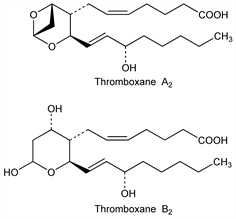
Derivative
Thromboxane A2.Nomenclature
Description and references
Highly unstable, biologically active bicyclic oxitane-oxane compound derived from the endoperoxide PGG2 and rapidly converted to thromboxane B2 by addition of water. Formed by incubation of arachidonic acid or PGG2 with washed platelets. It induces irreversible platelet aggregation and causes contraction of the isolated rabbit aorta and release of serotonin and ADP from platelets in platelet-rich plasma. Synthesis of stable analogs: E. J. Corey et al., Tetrahedron Lett. 1980, 137; K. M. Massey, G. M. Bundy, ibid. 445; S. Ohuchida et al., J. Am. Chem. Soc. 103, 4597 (1981); V. N. Kale, D. L. J. Clive, J. Org. Chem. 49, 1554 (1984). Synthesis of biologically active unstable analogs: S. S. Bhagwat et al., Tetrahedron Lett. 1985, 1955. Total synthesis and structure of thromboxane A2: eidem, Nature 315, 511 (1985). Formation and effects in human platelets: J. Svensson et al., Acta Physiol. Scand. 98, 285 (1970).
Properties
Biological half-life: 32 ±2 sec at 37°.Derivative
Thromboxane B2.Nomenclature
Description and references
A stable metabolite of thromboxane A2 in platelets, initially considered biologically inactive. It is released during anaphylaxis in isolated guinea pig lungs and has been isolated from guinea pig brain homogenates and carrageenin-induced granuloma. TXB2 has also been reported as possessing chemotactic properties. Total synthesis: N. A. Nelson, R. W. Jackson, Tetrahedron Lett. 1976, 3275; R. C. Kelly et al., ibid. 3279; from a prostaglandin F2a derivative: W. P. Schneider, R. A. Morge, ibid. 3283; stereospecific synthesis from d-glucose: S. Hanessian, P. Lavallee, Can. J. Chem. 55, 562 (1977); E. J. Corey et al., Tetrahedron Lett. 1977, 1625; S. Hanessian, P. Lavallee, Can. J. Chem. 59, 870 (1981). Metabolism: L. J. Roberts et al., J. Biol. Chem. 252, 7415 (1966). Biological properties: J. R. Boot et al., J. Physiol. 257, 47P (1976); L. S. Wolfe et al., Biochem. Biophys. Res. Commun. 70, 907 (1976); W.-C. Chang et al., Prostaglandins 13, 3 (1977).