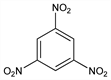
9726. sym-Trinitrobenzene
Nomenclature
CAS number: 99-35-4
1,3,5-Trinitrobenzene; benzite. C6H3N3O6; mol wt 213.10.
C 33.82%, H 1.42%, N 19.72%, O 45.05%.
Description and references
Prepared by decarboxylation of trinitrobenzoic acid, obtained by oxidation of TNT: Clarke, Hartman, Org. Synth. 2, 93 (1922); by the action of alkali on 2,4,6-trinitrobenzaldehyde: Secareanu, Bull. Soc. Chim. 51, 591 (1932). Use as explosive, less sensitive to impact than TNT but more powerful and brisant: Robertson, J. Chem. Soc. 119, 8 (1921); van Duin, Rec. Trav. Chim. 39, 687 (1920). Review of toxicology and human exposure: Toxicological Profile for 1,3-Dinitrobenzene and 1,3,5-Trinitrobenzene (PB95-264289, 1995) 168 p.