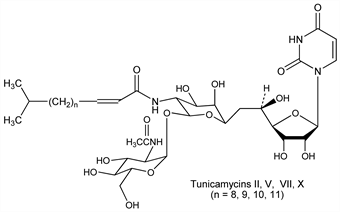
9819. Tunicamycin
Nomenclature
Description and references
A family of nucleoside antibiotics produced by Streptomyces lysosuperificus. Isoln, characterization: A. Takatsuki et al., J. Antibiot. 24, 215 (1971). Biological properties: A. Takatsuki, G. Tamura, ibid. 224. Effect on microorganisms: A. Takatsuki et al., ibid. 25, 75 (1972). Tunicamycin is produced as a mixture of at least 10 homologous antibiotics, the main components being tunicamycins V, VII, II and X, also referred to respectively as A, B, C, D. They contain uracil, N-acetylglycosamine, an 11-carbon aminodialdose called tunicamine, and a fatty acid linked to the amino group of tunicamine. The homologs differ in their fatty acid components, which vary in degree of saturation and chain length and branching. Structural elucidation: A. Takatsuki et al., Agric. Biol. Chem. 41, 2307 (1977); T. Ito et al., ibid. 44, 695 (1980). HPLC sepn of components: W. C. Mahoney, D. Duskin, J. Biol. Chem. 254, 6572 (1979). Approaches to synthesis: Y. Fukuda et al., Bull. Chem. Soc. Jpn. 55, 880 (1982). Tunicamycin has been shown to interfere with glycoprotein synthesis in yeast and mammalian systems: A. Takatsuki et al., Agric. Biol. Chem. 39, 2089 (1975); S. Kuo, J. O. Lampen, Arch. Biochem. Biophys. 172, 574 (1976). Effect on epidermal glycoprotein and glycosaminoglycan synthesis in vitro: I. A. King, A. Tabiowo, Biochem. J. 198, 331 (1981). Enhancement of antiviral and anticellular activity of interferon, q.v.: R. K. Maheshwari et al., Science 219, 1339 (1983). Review: A. D. Elbein, Trends Biochem. Sci. 6, 219-221 (1981). Book: Tunicamycin, G. Tamura, Ed. (Japan Sci. Soc., Tokyo, 1982) 220 pp. See also Streptovirudin.