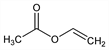
9992. Vinyl Acetate
Nomenclature
Description and references
Prepn: Schnizer, US 2859241 (1958 to Celanese); Sharp, Steitz, US 2860159 (1958 to Pan Am. Petroleum); Foster, Tobler, J. Am. Chem. Soc. 83, 851 (1961). Toxicity data: Smyth, Carpenter, J. Ind. Hyg. Toxicol. 30, 63 (1948). Study of chronic human exposure: Deese, Joyner, Am. Ind. Hyg. Assoc. J. 30, 449 (1969). Reviews: Leonard “Vinyl Acetate” in Vinyl and Diene Monomers (part 1), E. C. Leonard, Ed. (Wiley-Interscience, New York, 1970) pp 263-328; Faith, Keyes & Clark's Industrial Chemicals, F. A. Lowenheim, M. K. Moran, Eds (Wiley-Interscience, New York, 4th ed., 1975) pp 862-867; W. Daniels, “Poly(Vinyl Acetate)” in Kirk-Othmer Encyclopedia of Chemical Technology vol. 23 (Wiley-Interscience, New York, 3rd ed., 1983) pp 817-847. Review of toxicology and human exposure: Toxicological Profile for Vinyl Acetate (PB93-110898, 1992) 166 pp.