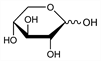
10087. Xylose
Nomenclature
CAS number: 58-86-6
d-Xylose; wood sugar; Xylomed (Bio-Medical); Xylo-Pfan (Savage). C5H10O5; mol wt 150.13.
C 40.00%, H 6.71%, O 53.29%.
Description and references
Widely distributed in plant materials, especially in wood (maple, cherry), in straw, in hulls. Not found in free state, but in form of xylan, a polysaccharide built from d-xylose units and occurring in association with cellulose. Xylose occurs also as part of glycosides. Isoln from corn cobs by boiling with 8% H2SO4: Monroe, J. Am. Chem. Soc. 41, 1002 (1919). Peanut shells and cottonseed hulls also are practical sources of xylose: Ling, Nanji, J. Chem. Soc. 1923, 620. Configuration: Hudson, Yanovsky, J. Am. Chem. Soc. 39, 1029 (1917); Haworth, Nature 116, 430 (1925). Review on history, constitution and prepn: Harding, Sugar 24, 14 (1922).
Properties
Monoclinic needles or prisms. Very sweet taste. mp 144-145° (Wheeler, Tollens, Ann. 254, 309); mp 153-154° (Hébert, Compt. Rend. 110, 970). d420 1.525. Shows mutarotation. [α]D20 +92° → +18.6° (16 hrs c = 10). One gram dissolves in 0.8 ml water. Sol in pyridine, hot alcohol. pKa (18°): 12.14. Reduces warm Fehling's soln. Upon heating with water in closed tube to 140° or by boiling with dil H2SO4, furfurol is formed.Use
In tanning, dyeing, and as a diabetic food.Therapeutic Category
Diagnostic aid (intestinal function).
Keywords
Diagnostic Aid