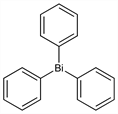
10261. Triphenylbismuth
Nomenclature
CAS number: 603-33-8
Triphenylbismuthine. C18H15Bi; mol wt 440.29.
C 49.10%, H 3.43%, Bi 47.46%.
Description and references
Homoleptic Bi(III) reagent. Prepn from phenylmagnesium bromide and bismuth halides: P. Pfeiffer et al., Ber. 37, 4620 (1904); A. Classen, O. Ney, Z. Anorg. Allg. Chem. 15, 253 (1921) DOI. Thermal properties: W. V. Steele, J. Chem. Thermodyn. 11, 187 (1979) DOI. Crystal structure: D. M. Hawley, G. Ferguson, J. Chem. Soc. A 1968, 2059 DOI; P. G. Jones et al., Z. Kristallogr. 210, 377 (1995). Synthetic applications in prepn of bismuth thiolates and carboxylates: P. C. Andrews et al., J. Chem. Soc. Dalton Trans. 2002, 4634 DOI. Effects on radiopacity and flexural properties of polymeric dental resins: L. A. Lang et al., J. Prosthodont. 9, 23 (2000) DOI PubMed.