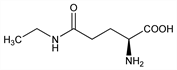
10270. Theanine
Nomenclature
Description and references
Predominant amino acid found in leaves of the tea plant, Camellia sinensis (L.) O. Kuntze, Theaceae; umami taste-enhancing component of green tea. Used in nutraceutical formulations for its relaxation effect. Prepn: N. Lichtenstein, J. Am. Chem. Soc. 64, 1021 (1942) DOI. Isoln from Japanese green tea leaves: Y. Sakato, Nippon Nogei Kagaku Kaishi 23, 262 (1950), C.A. 45, 3528f (1951). Synthesis: H. Kawagishi, K. Sugiyama, Biosci. Biotechnol. Biochem. 56, 689 (1992); H. Gu et al., Org. Prep. Proced. Int. 36, 182 (2004). HPLC determn in tea leaves: Y. Ying et al,. J. Liq. Chromatogr. Relat. Technol. 28, 727 (2005) DOI. LC/MS determn in plasma and urine and pharmacokinetics of enantiomers: M. J. Desai et al., Chirality 17, 154 (2005) DOI PubMed. Impact on taste of green tea: S. Kaneko et al., J. Agric. Food Chem. 54, 2688 (2006) DOI PubMed. Review of physiological effects: M. Ozeki et al., in Nutraceutical Proteins and Peptides in Health and Disease (CRC Press, Boca Raton, 2006) pp 377-390. Review of psychological effects on anxiety and cognitive performance: J. Bryan, Nutr. Rev. 66, 82-90 (2008) DOI PubMed.