10288. 2′,7′-Dichlorofluorescein

Nomenclature

CAS number: 76-54-0
2′,7′-Dichloro-3′,6′-dihydroxyspiro[isobenzofuran-1(3H),9′-[9H]xanthen]-3-one; 2′,7′-dichloro-3,6-fluorandiol; dichlorofluorescein.
C20H10Cl2O5; mol wt 401.20.
C 59.87%, H 2.51%, Cl 17.67%, O 19.94%.

Description and references

Fluorescent dye. Prepn and use as argentometric titration indicator: I. M. Kolthoff et al., J. Am. Chem. Soc. 51, 3273 (1929) DOI. Dissociation and tautomerism: N. O. Mchedlov-Petrossyan et al., J. Phys. Org. Chem. 16, 380 (2003) DOI; and NMR spectroscopy: M. Afri et al., Chem. Phys. Lipids 131, 123 (2004) DOI PubMed. Acid-base equilibrium studies: H. Leonhardt et al., J. Phys. Chem. 75, 245 (1971) DOI. Chromatographic purification: W. A. Peeples II, J. R. Heitz, J. Liq. Chromatogr. 4, 51 (1981) DOI. Laser dye studies: R. W. Chambers, D. R. Kearns, Photochem. Photobiol. 10, 215 (1969) DOI PubMed; D. A. Jennings, A. J. Varga, J. Appl. Phys. 42, 5171 (1971) DOI; M. Yamashita et al., J. Chem. Phys. 66, 986 (1977) DOI. Prepn and applications of fluorescent derivatives: S. C. Burdette et al., J. Am. Chem. Soc. 123, 7831 (2001) DOI PubMed.
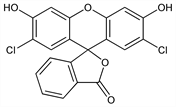
Chemical structure

Properties

Ochre solid. Irritant. Exists as pH dependent tautomers. Unconjugated lactonic form predominates at acidic, neutral pH; lacks typical uv absorption and fluorescence. Lactonic form: Absorption max (DMF): 470 nm (ε 380). Open form is fully conjugated across tricyclic system at basic pH. Open form: Absorption max (ethanol): 509 nm; (DMF): 526 nm (ε 89600). Fluorescence excitation max: 395 nm; emission max: 450 nm. pKa0 (DMF) <1; pKa1 (DMF) 10.4±0.2; pKa2 (DMF) 13.2±0.1. Sol in ethanol and aq alkali solns; slightly sol in methanol and ether. Practically insol in water.

Use

Fluorescent indicator dye; also used in lasers. Indicator for argentometric titration of chloride and bromide ions. Fluorimetric dip reagent. Fluorescent derivatives as probes for protein labeling and metal ion detection.