|
|
|
|
|
|
|
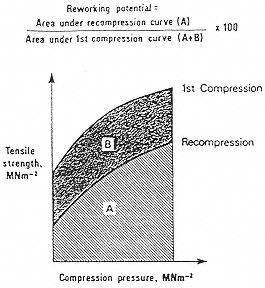
Fig. 1
Excipient reworkability. |
|
|
|
|
|
|
|
|
tableting pressure, the lower the ability of the tablets to be reworkedan observation consistent with the concept of work-hardening during the initial compression. |
|
|
|
|
|
|
|
|
3. Response to Force and Loading Rate |
|
|
|
|
|
|
|
|
a. Modes of Deformation Aulton et al. (1974), suggested that tableting materials which deform plastically, with little elastic recovery, should produce better quality tablets than more resilient materials. In their study, hardness determined by indentation under a fixed load and the elastic recovery from the indentation were measured over the faces of tablets prepared from direct-compression excipients. An elastic quotient was calculated, i.e., the fraction of the indentation that rebounds elastically on removal of the load of compression. The ratios indicate that the tablets prepared from direct-compression materials generally have a lower elastic recovery, and therefore must have undergone greater plastic deformation than the poorer tableting materials. Employing this concept as a single criterion in order of tableting performances, from good to less satisfactory, the excipients studied could be ranked as follows: compressible starch, dibasic calcium phosphate (dihydrate), sucrose, a dextrate (Celutab), anhydrous lactose, and microcrystalline cellulose. Micro- |
|
|
|
|
|