|
|
|
|
|
|
|
F: = FL3×(FE×FL1+FL×(1-FL1)) + (1-FL3)×FM |
|
|
|
|
|
|
|
|
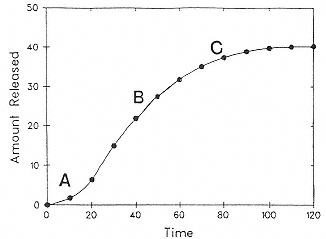
Figure 17 depicts this model. The original equation has been modified to incorporate the initial gradual release phase. The switch between FE and FL is arbitrarily set to occur when the slopes of both functions (segments A and B) of Fig. 17 are equal to allow for a smooth transition. |
|
|
|
|
|
|
|
|
c. Utility of Makoid-Banakar Functions in Product Development The use of these functions in drug product development is twofold. |
|
|
|
 |
|
|
|
|
1. The formulation scientist can decide a priori the value of T peak (duration of drug delivery) and A (+ve, -ve, or 0). In so doing, one can back calculate |
|
|
|
|
|
|
|
|
Fig. 17
Dissolution data fit to Makoid-Banakar function modified
for gradual early release [data from J. Pharm. Sci. 70:
535, 1970]. |
|
|
|
|
|