|
|
|
|
|
|
|
Makoid-Banakar function. A plot of the individual parameters versus the variable would yield insight into that variable's effect on the overall profile. If the preformulation decision has been made as to what the optimal release profile should look like, then these relationships would yield a working road map for experimental design. The model might quickly determine whether the presence of an excipient might yield a profile of the desired shape, without having to formulate and test all the permutations. While detailed information regarding the excipients is not readily available, the trend is to make such information more readily accessible, particularly in the area of polymers. Thus in the near future, the performance of formulations might be able to be predicted from a parameter (for example polymer index) of the polymer used. |
|
|
|
|
|
|
|
|
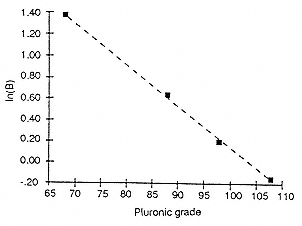
Reviewing the recent literature yielded a couple of examples of release profiles as a function of an excipient that can be analyzed as we discussed. Gilbert and Whiteman (1991) presented a paper at the recent CRS meeting in which they presented the release profile of methylparahydroxybenzoate (MEPB) formulated in matrices of pluronics of various molecular weights. Graphs of B and C determined from the release profiles provided versus pluronic grade (molecular weight) (Figs. 22 and 23) show clear relationships that can be used to aid in formulation decision. |
|
|
|
|
|
|
|
|
The parameters B and C are linked so that not all combinations of B and C are available using the pluronics and simply varying the molecular weight. If the optimal system parameters, as previously defined in the preformulation stages, fall on or close to the line in Fig. 24, then the molecular weight of |
|
|
|
|
|
|
|
|
Fig. 22
Effect of molecular weight on the initial zero-order
release constant in (B) of MEPB. |
|
|
|
|
|