|
|
|
|
|
|
|
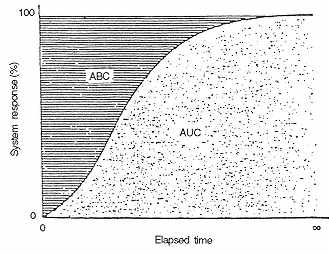
Fig. 30
Schematic illustration of system response as a function of
elapsed time [from Pharm. Tech. 7: 103, 1984]. |
|
|
|
|
|
|
|
|
process with data from dissolution-time profiles (Fig. 31a) and plasma-concentration-time profiles (Fig. 31b) for six of seven commercially available phenobarbital tablet formulations demonstrates the utility of the process. |
|
|
|
|
|
|
|
|
1. Treatment of Bioavailability Data |
|
|
|
|
|
|
|
|
STEP 1: Curve-fit the plasma-concentration-time data to the equation in MINSQ format: |
|
|
|
|
|
|
|
|
CP = I×KA/(KA-K)×(EXP(-K×T)-EXP(-KA×T) (1) |
|
|
|
|
|
|
|
|
where I = FD/V and KA and K are the absorption rate constant and the elimination rate constant, respectively. This yields a standard plasma concentration versus time profile for each of the preparations. |
|
|
|
|
|
|
|
|
STEP 2: Transform the plasma data. |
|
|
|
|
|
|
|
|
Integration of the Cp versus T profile yields the cumulative AUC versus T profile. Using either the AUC from an intravenous dose (absolute bioavailability) or from the innovator oral product (comparative bioavailability), the fractional system response is calculated by: |
|
|
|
|
|