|
|
|
|
|
|
|
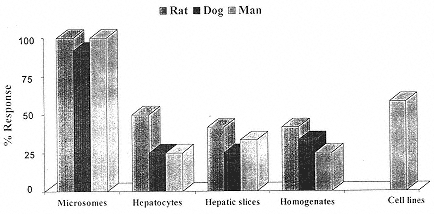
There is increasing awareness of the potential usefulness of in vitro metabolism. In a recent survey [23], it was shown that more than 80% of UK companies are now undertaking such investigations at some time during drug development (Figure 2). Although most are undertaking in vitro metabolic studies prior to clinical trials, relatively few (17%) are using this approach to aid candidate drug selection. This situation will probably change since the information that can be acquired is valuable for choosing candidate drugs before taking them into full development, providing information on 1) the extent, rate and routes of metabolism; 2) the comparative metabolic profiles to choose the large species (dog or primate) to be used in long-term toxicity; 3) the isolation, production and identification of major metabolites for analysis and synthesis; 4) the clearance predictions to estimate the degree of first-pass metabolism and whole-body clearance (see scaling); and 5) identification of which enzyme is involved to predict potential clinical problems of polymorphism, drug interaction, inhibition, etc. |
|
|
|
|
|
|
|
|
Several methods are currently being used: (a) microsomes, which have the advantage of ease of production, storage, and availability but do not have the ability to metabolize drugs by Phase II conjugation reactions or various oxidation reactions catalyzed by monoamine oxidase (MAO), flavin monooxygenase (FMO), etc,; (b) hepatocytes, which possess all metabolic capabilities but are difficult to produce and cannot be stored for more than 2448 hours; (c) hepatic slices, which are good as metabolite factories but have similar draw- |
|
|
|
|
|
|
|
|
Fig. 2
The comparative use of in vitro metabolic methods used by UK pharmaceutical
companies (n = 18) in different species. (From Ref. 23.) |
|
|
|
|
|