|
|
|
|
|
|
|
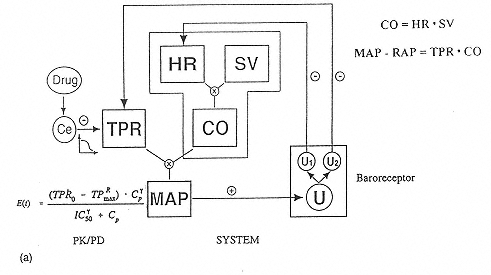
described the time course of the feedback control following a sudden change in blood pressure. The resulting modifications of the cardiovascular system took seconds and minutes in the case of baroreceptors, hours in the case of vascular changes, and days in the case of renal function. Thus, to more fully understand the complexities of the effect of a medicine, it is also necessary to model these changes in conjunction with the changes in drug levels. The action of warfarin on blood clotting takes at least 24 hours due to the cascade effect on clotting factors. This can be modeled physiologically by building into a receptor-based model additional algorithms for the rate of synthesis and clearance of prothrombin [72]. The effect of cocaine on heart rate needs the additional physiological input of the circadian sinus rhythm of this frequency to adequately describe the resulting action of the drug [73]. Feedback control of a drug's action or tachyphylaxis is a well-known consequence of drug action |
|
|
|
|
|
|
|
|
 |
|
|
|
|
|
|
|
|
Fig. 8
(a) Physiological systems mathematical model for kinetic-dynamic relationships of the
cardiovascular activity of Nicardipine, where TPR = total peripheral resistance,
MAP = mean arterial pressure, HR = heart rate, SV = stroke volume, and
CO = cardiac output. (b) Predicted (-) and actual ( , ,  , ,  ) values for blood levels ) values for blood levels
(Cp), total peripheral resistance (TPR), cardiac output (CO), and mean blood pressure
(map) in human volunteers (n=6) following different infusion rates of Nicardipine
using systems physiological model. (From Ref. 74.) |
|
|
|
|
|