|
|
|
|
|
|
|
is also intended to demonstrate the close collaboration needed between clinical pharmacologists and scientists in discovery research, drug metabolism, bio- analysis, pharmaceutics, clinical research, and academia. |
|
|
|
|
|
|
|
|
Problem 1: An oral drug solution from an investigational effervescent tablet was found to be only 50% as well absorbed as the marketed tablet. Why did this occur? Could an alternative solution be made that is bioequivalent to the tablet? This problem was thought to be odd in that drugs from oral solutions are generally thought to be absorbed as well or better than from tablets since there is no restriction from dissolution. |
|
|
|
|
|
|
|
|
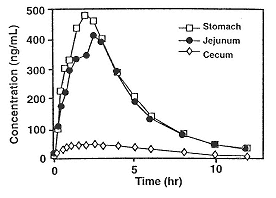
When this problem occurred it was known that ranitidine is about 5060% absorbed and that the absorption profile is frequently characterized by double peaks over a 4-hour period. A study had just been completed where ranitidine was administered by a tube into the stomach, jejunum, and cecum [3]. The results demonstrated ranitidine was virtually not absorbed after leaving the small bowel (Figure 2). |
|
|
|
|
|
|
|
|
Of the many possibilities investigated, it was noted that the ranitidine absorption pattern from the oral solution was different from the tablet in that the absorption portion of the curve terminated earlier for the solution. One of the ingredients in the solution, sodium acid pyrophosphate (SAPP), was thought to be present in a large enough quantity to be speeding small bowel transit time and possibly sweeping the drug past the site of absorption. Clinical studies then found that a ranitidine solution without SAPP was as well absorbed as the tablet. The addition of SAPP to the ranitidine solution decreased absorption by 50% and produced a profile similar to the first bioavailability study. Gamma scintigraphy confirmed that SAPP was decreasing small-bowel |
|
|
|
|
|
|
|
|
Fig. 2
Ranitidine mean (n=8) plasma concentration
versus time after giving 150 mg by nasogastric
tube into the stomach, jejunum, and cecum. |
|
|
|
|
|