|
|
|
|
|
|
|
people who oppose partnerships |
|
|
|
|
|
|
|
|
lack of control over personnel decisions |
|
|
|
|
|
|
|
|
reduced contact with investigators |
|
|
|
|
|
|
|
|
If contracting in is beginning to sound more risky than advantageous, do not stop reading now. Yes, there are risks. But as Christopher Ball, CEO of a biotech company in the Pacific Northwest, points out, despite the many risks, contract research poses as many (if not more) benefits and opportunities [7]. The key lies in understanding the risks and managing them intelligently and effectively; we will discuss some effective strategies for doing so in subsequent sections of this chapter. |
|
|
|
|
|
|
|
|
IV. Whether and How to Contract in: The Decision-Making Process |
|
|
|
|
|
|
|
|
A. Evaluating the Need for a CRO |
|
|
|
|
|
|
|
|
The process of choosing a CRO begins with defining specific needs within an organization. The most common circumstances under which a CRO might be considered include |
|
|
|
|
|
|
|
|
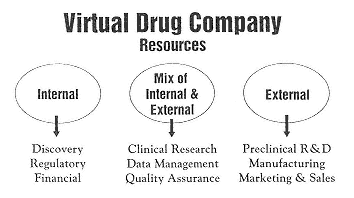
Fig. 1
Illustration of how a small pharmaceutical or biotechnology
company might allocate resources for drug development,
combining its own internal resources with outside resources
to create an efficient virtual company structure. The
internal resources listed on the left comprise the
company's core areas of expertise. Next, the mix of internal
and external resources shown here reflects how the company
could augment its internal resources with outside
resources in particular areas to manage the actual
development process efficiently.
Finally, purely external resources could be used
to manufacture and market the
drugperhaps even as a consequence of selling rights to
the new product to a third partyonce development
is complete. |
|
|
|
|
|