|
|
|
|
|
|
|
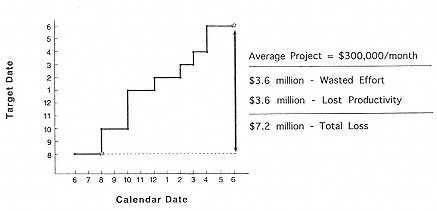
Fig. 3
Effect of delayed termination on R & D costs. The graph shows a series of
adjustments by management over the course of one year, each time resetting
and delaying the decision to terminate a project. For a project costing $300,000
per month in internal resources, the cost to R & D of the delayed decision
is $3.6 million for unnecessary work done on the terminated project, plus $3.6
million in lost productivity on a higher priority project because resources
from the unsuccessful project could not be assigned to it. |
|
|
|
|
|
|
|
|
cient latitude for exploring unexpected findings. Approved projects should be measured periodically against their plan to assess progress. Projects that are not making adequate progress are easy to spot. |
|
|
|
|
|
|
|
|
Development progress, on the other hand, can be more easily assessed. A development plan with milestone decisions is an integral part of drug development. A negative or unexpected observation should be taken very seriously as a harbinger of worse things to come [28]. This is because in development a drug moves progressively from more-controlled to less-controlled experimental conditions. If there are troublesome results early on, they will likely be compounded in larger, less-controlled studies. Problems do not magically go away. Many teams slip into salvage mode: trying to figure out why an unexpected result was seen; trying to bury it in statistics by increasing the number of observations through repeated retesting; or sidetracking the entire project by developing a whole new line of studies to overcome the problem. These are not wise approaches. |
|
|
|
|
|
|
|
|
For both discovery and development projects, a back-up strategy that anticipates unexpected findings should be formulated as part of the original research or development plan. This strategy should include a clear understanding of the conditions under which the project should be terminated. When difficulties arise, as they invariably do, the back-up strategy should be |
|
|
|
|
|