|
|
|
|
|
|
|
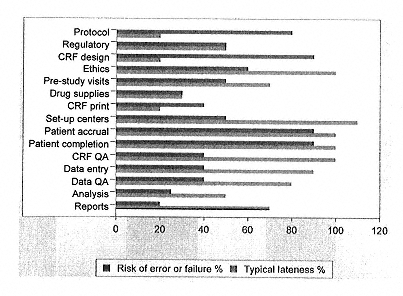
FIG. 3
Clinical research risks: Risk of error or failure and typical lateness. |
|
|
|
|
|
|
|
|
be considered. What is possibly less obvious is the risk of any early-phase design errors to later phases and to the whole drug project. |
|
|
|
|
|
|
|
|
Once phase III is imminent, perhaps there is a degree of confidence emerging, as much more is known about the drug. The requirement for phase III, therefore, may be seen as accumulating data to enable a product license application. In fact, the great expansion of activity dictated by phase III studies introduces even more complexity and a new set of risks. The application of the drug to a more realistic clinical setting means that we will not necessarily by studying clean patients. Patients will often have other diseases on top of that under study and will only be under observation for a small proportion of the time. Attention to protocol design, thus, is at least as critical as in phases III. |
|
|
|
|
|
|
|
|
2.
Key Tasks and External Agencies |
|
|
|
|
|
|
|
|
The most common reason for late tasks and projects is that they started late. Before patients can be screened for entry, a well-established set of start-up tasks must be completed, and of these, some are relatively easy to plan, and others are less predictable. Those relying on internal agreements (e.g., drug supplies, protocol sign-off), can be expedited by instilling the right culture |
|
|
|
|
|