Nomenclature
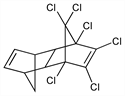
CAS number: 309-00-2
1,2,3,4,10,10-Hexachloro-1,4,4a,5,8,8a-hexahydro-1,4:5,8-dimethanonaphthalene; HHDN; compd 118; Octalene.
C
12H
8Cl
6; mol wt 364.91.
C 39.50%, H 2.21%, Cl 58.29%.
Description and references
Chlorinated hydrocarbon insecticide; readily
metabolized to dieldrin, q.v. Activity: C. W. Kearns et al., J. Econ. Entomol. 42, 127 (1949). Prepn of
aldrin and endo,endo-isomer: Lidov, US 2635977 (1953 to Shell). Alternate syntheses: Schmerling, US 2911447 (1959 to Universal Oil Prod.); Korte, Rechmeier, Ann. 656, 131 (1962). Toxicity study: T. B. Gaines, Toxicol. Appl. Pharmacol. 14, 515
(1969). Review of toxicology and human exposure: Toxicological Profile for Aldrin/Dieldrin (PB2003-100134, 2002) 354 pp.
Properties
Crystals, mp 104°. Vapor pressure at 20°: 7.5×105 mm
Hg. Very sol in most organic solvents. Practically insol in water.
Stable in presence of organic and inorganic alkalies; stable to the
action of hydrated metal chlorides. LD50 in male, female rats (mg/kg): 39, 60 orally (Gaines).Derivative
endo,endo-Isomer.
Nomenclature
Isodrin; compd 711. Properties
Crystals, mp 240-242°. LD50 in male,
female rats (mg/kg): 15, 7.0 orally (Gaines).Caution
Potential symptoms of overexposure
by ingestion, inhalation, or skin absorption are headache, dizziness;
nausea, vomitting, malaise; myoclinic limb jerks; clonic and tonic
convulsions; coma; hematuria, azotemia. Potential occupational carcinogen.
See NIOSH Pocket Guide to Chemical Hazards (DHHS/NIOSH 97-140, 2003) p 8; Patty's Industrial
Hygiene and Toxicology vol. 2B, G. D. Clayton,
F. E. Clayton, Eds. (Wiley-Interscience, New York, 4th ed., 1994)
pp 1517-1523.Use
Formerly as insecticide.