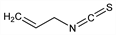
295. Allyl Isothiocyanate
Nomenclature
Description and references
Principal constituent of volatile oil of mustard. Occurs in seeds as the glucoside, sinigrin, q.v. Isolated from Brassica nigra (L.) Koch, Cruciferae (black mustard seed), or prepd from allyl iodide and potassium thiocyanate: Dulière, J. Pharm. Belg. 2, 981 (1920), C.A. 15, 5714 (1921). Description: E. Guenther, D. Althausen, The Essential Oils vol. II (Van Nostrand, New York, 1949) pp. 734-7. Review of isolation: E. Guenther, ibid. vol VI, 55-60 (1952); and synthesis: G. M. Dyson, Perfum. Essent. Oil Rec. 20, 42 (1929). Evaluation in relieving muscle pain: J. G. Macarthur, S. Alstead, Lancet 2, 1060 (1953). Toxicity study: P. M. Jenner et al., Food Cosmet. Toxicol. 2, 327 (1964). HPLC determn in brown mustard: K. Kanemaru et al., J. Jpn. Soc. Food Sci. Technol. 37, 565 (1990).
Properties
Colorless or pale yellow, very refractive liquid; very pungent, irritating odor; acrid taste. Flammable, poisonous. d415 1.024. bp 152°. nD25 1.5248. Slightly sol in water. Misc with alcohol, carbon disulfide, ether. One ml dissolves in 8 ml 70% alcohol. LD50 orally in rats: 339 mg/kg (Jenner).Use
Manuf flavors; war gas.Therapeutic Category
Counterirritant.