307. Aloin
Nomenclature
CAS number: 5133-19-7
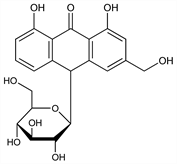
10-Glucopyranosyl-1,8-dihydroxy-3-(hydroxymethyl)-9(10H)-anthracenone; 1,8-dihydroxy-3-hydroxymethyl-10-(6-hydroxymethyl-3,4,5-trihydroxy-2-pyranyl)anthrone; 10-(1′,5′-anhydroglucosyl)-aloe-emodin-9-anthrone; barbaloin. C21H22O9; mol wt 418.39.
C 60.28%, H 5.30%, O 34.42%.
Description and references
Isoln from various species of aloe (Cape, Uganda and Socotrine): Léger, Ann. Chim. 6, 318 (1916); 8, 265 (1918); Cahn, Simonsen, J. Chem. Soc. 1932, 2573; Rosenthaler, Arch. Pharm. 270, 214 (1932); Mühlemann, Pharm. Acta Helv. 27, 17 (1952); Bhme, Bertram, Arch. Pharm. 288, 510 (1955). The molecule is built from aloe-emodin, q.v., and from glucose. Structure: Hay, Haynes, J. Chem. Soc. 1956, 3141.
Properties
Lemon-yellow crystals, mp 148-149°. Quickly forms a monohydrate, mp 70-80°. Slight odor of aloe; bitter taste. Solubility at 18°: 57% in pyridine, 7.3% in glacial acetic acid, 5.4% in methanol, 3.2% in acetone, 2.8% in methyl acetate, 1.9% in ethanol, 1.8% in water, 1.6% in propanol, 0.78% in ethyl acetate, 0.27% in isopropanol. Very slightly soluble in isobutanol, chloroform, carbon disulfide, ether. Incompatible with alkali hydroxides, tannin, ferric chloride.Therapeutic Category
Cathartic.
Therapeutic Category (Veterinary)
Purgative.Keywords
Laxative/Cathartic