306. Aloe-Emodin
Nomenclature
CAS number: 481-72-1
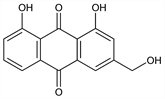
1,8-Dihydroxy-3-(hydroxymethyl)-9,10-anthracenedione; 1,8-dihydroxy-3-(hydroxymethyl)anthraquinone; 3-hydroxymethylchrysazin; rhabarberone. C15H10O5; mol wt 270.24.
C 66.67%, H 3.73%, O 29.60%.
Description and references
Occurs in the free state and as a glycoside in Rheum (rhubarb), in senna leaves and in various species of Aloe (Liliaceae). Isolation: Condo-Vissicchio, Arch. Pharm. 247, 81 (1909); Mary et al., J. Am. Pharm. Assoc. 45, 229 (1956). Prepn: Cahn, Simonsen, J. Chem. Soc. 1932, 2573; Hay, Haynes, ibid. 1956, 3141; Bapat et al., Tetrahedron Letters no. 5, 15 (1960). HPLC determn in plasma: M. Zaffaroni et al., J. Chromatogr. B 796, 113 (2003).
Properties
Orange needles from toluene, mp 223-224°. Sublimes in CO2 stream. Absorption spectrum: Stone, Furman, J. Am. Chem. Soc. 68, 2742 (1946). Freely sol in hot alcohol, in ether, in benzene with yellow color, in ammonia water and in sulfuric acid with crimson color.Derivative
Trimethyl ether.C18H16O5; mol wt 312.32.
C 69.22%, H 5.16%, O 25.61%.
Properties
Orange needles from acetic acid, mp 163°.Derivative
Triacetate.C21H16O8; mol wt 396.35.
C 63.64%, H 4.07%, O 32.29%.
Properties
Yellow needles from benzene, mp 175-177°.Note
See also Emodin.Therapeutic Category
Cathartic.
Keywords
Laxative/Cathartic