627. Anatoxins
Nomenclature
ANTXS.Description and references
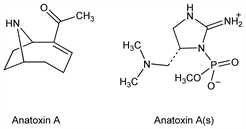
First isolated, freshwater neurotoxins present in algal blooms associated with a number of blue-green cyanobacteria including Anabaena. spp., Aphanizomenon spp. and Oscillatoria spp. Responsible for fatal poisoning of cattle and wildlife as well as human illness worldwide. Review: W. W. Carmichael et al., ACS Symp. Ser. 418, 87-106 (1990). Review of occurence, chemistry and analysis: K. Sivonen, Food Sci. Technol. 103, 567-581 (2000).
Derivative
Anatoxin a.Nomenclature
Description and references
Alkaloid post-synaptic depolarizing neuromuscular blocker acting as a nicotinic cholinergic receptor agonist. Isoln and purification: J. P. Devlin et al., Can. J. Chem. 55, 1367 (1977). Improved purification: K. Harada et al., Toxicon 27, 1289 (1989). Synthesis: H. F. Campbell et al., Can. J. Chem. 55, 1372 (1977); stereoselective synthesis: M. Skrinjar et al., Tetrahedron: Asymmetry 3, 1263 (1992). TLC determn in algal material: I. Ojanpera et al., Analyst 116, 265 (1991); by LC/MS in cyanobacteria and drinking water: A. Furey et al., Rapid Commun. Mass Spectrom. 17, 583 (2003). Review of syntheses: H. L. Mansell, Tetrahedron 52, 6025-6061 (1996).
Properties
[α]D25 +39.8° (c = 0.676 in abs. ethanol). pKa: 9.4 Degrades readily in sunlight and high pH to non-toxic products. LD50 i.p. in mice: 200 μg/kg (Carmichael).Derivative
Anatoxin a(s).Nomenclature
Description and references
Irreversible acetylcholinesterase inhibitor; only known organophosphate toxin found in cyanobacteria. The (s) refers to the production of excess saliva upon ingestion. Identification and preliminary purification: N. A. Mahmood, W. W. Carmichael, Toxicon 24, 425 (1986); anticholinesterase activity: eidem, ibid. 25, 1221 (1987). Mechanism of action: E. G. Hyde, W. W. Carmichael, J. Biochem. Toxicol. 6, 195 (1991). Pharmacology in rat: W. O. Cook et al., J. Environ. Pathol. Toxicol. Oncol. 9, 393, (1989). Biosensor determn in water: F. Villatte et al., Anal. Bioanal. Chem. 372, 322 (2002).