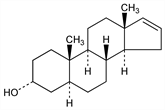
639. (3α,5α)-Androst-16-en-3-ol
Nomenclature
Description and references
A major constituent of boar pheromone, having a pronounced musk-like odor. Isoln from swine testes: V. Prelog, L. Ruzicka, Helv. Chim. Acta 27, 61 (1944). Prepn: V. Prelog et al., ibid. 66; J. Fishman et al., J. Org. Chem. 28, 1443 (1963). Physiological role as a sex attractant for pigs: D. B. Gower, J. Steroid Biochem. 3, 45 (1972). Use in pig artificial insemination: D. R. Melrose et al., DE 1937264; eidem, US 3681490 (1970, 1972 both to Nat. Res. Dev. Corp.). In vivo metabolism in boar testes: Y. A. Saat et al., Biochem. J. 144, 347 (1974). It has also been detected in human male axillary sweat, but has no androgenic activity: B. W. L. Brooksbank et al., Experientia 30, 864 (1974). Radioimmunoassay: D. C. Bickell, D. B. Gower, J. Steroid Biochem. 7, 451 (1976). Receptor studies: J. N. Gennings et al., Biochim. Biophys. Acta 496, 547 (1977). Biosynthetic studies: E. L. Hurden et al., J. Endocrinol. 81, 161P (1979); G. M. Cook, D. B. Gower, ibid. 88, 409 (1981). Discovery of the presence of androst-16-en-3-ol in truffles (Tuber melanosporum) has been offered as an explanation for the ability of pigs to detect truffles growing as deep as 1 meter underground: R. Claus et al., Experientia 37, 1178 (1981).