Nomenclature
CAS number: 84-65-1
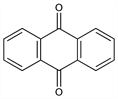
9,10-Anthracenedione; 9,10-anthraquinone; 9,10-dioxoanthracene; Flight Control (DCV).
C
14H
8O
2; mol wt 208.21.
C 80.76%, H 3.87%, O 15.37%.
Description and references
Prepn: A. Laurent, Ann. 34, 287 (1840). Structural relationship
with anthracene: C. Graebe, C. Liebermann, Ber. 2, 332 (1869). Industrial prepn from
phthalic anydride and benzene: Klipstein, Ind. Eng. Chem. 18, 1327 (1926). From anthracene
with vanadium pentoxide, sodium chlorate, glacial acetic and sulfuric
acids: Org. Synth. coll.
vol. II, 554 (1943). Convenient lab procedure: L. F. Fieser, Organic Experiments (Heath & Co., Boston,
1964) pp 195-200. Review of chemistry: M. Phillips, Chem. Rev. 6, 157 (1929); of manufacture
and uses: A. J. Cofrancesco in Kirk-Othmer
Encyclopedia of Chemical Technology Vol. 2 (Wiley-Interscience,
New York, 4th ed., 1992) pp 801-814. Development as bird repellent:
R. M. Poché, Proc. 18th Vertebr. Pest Conf. 1998, 338. Field trial to control Canadian geese: P.
Devers et al. ibid. 345.
Properties
Light yellow, slender monoclinic prisms by sublimation in vacuo. Almost colorless, orthorhombic, bipyramidal crystals
from H2SO4 + H2O. d420 1.42-1.44. mp 286°. bp760 377°. Absorption spectrum: Flexser et al., J. Am. Chem. Soc. 57, 2103 (1935).
Insol in water. Solubility (g/100 g) in alc at 18° 0.05; at 25°
0.44; in boiling alc 2.25; in ether at 25° 0.11; in chloroform at
20° 0.61; at 40° 1.00; at 60° 1.60; in benzene at 20° 0.26; at 40°
0.50; at 60° 1.00; at 80° 1.80; in toluene at 25° 0.30.Caution
Low acute oral toxicity, but may
cause skin irritation, sensitization. See Clinical Toxicology of Commercial Products, R. E. Gosselin et al., Eds. (Williams & Wilkins,
Baltimore, 5th ed., 1984) Section II, p 189.Use
Starting material for the manufacture of dyes; bird
repellent.