1009. Batrachotoxin
Nomenclature
Description and references
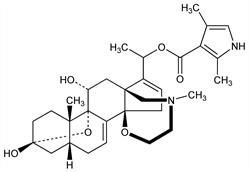
One of a group of toxic steroidal alkaloids consisting of batrachotoxin, pseudobatrachotoxin, homobatrachotoxin, and batrachotoxinin A. Extracted orginally from the skin of South American poison-dart frogs, genus Phyllobates. Its name is derived from the Greek word “batrachos” meaning frog. Isoln: F. Mrki, B. Witkop, Experientia 19, 329 (1963); and preliminary characterization: J. W. Daly et al., J. Am. Chem. Soc. 87, 124 (1965). Structure: T. Tokuyama et al., ibid. 91, 3931 (1969). Synthetic studies: J. F. W. Keana, R. R. Schumaker, J. Org. Chem. 41, 3840 (1976); P. Magnus et al., Chem. Commun. 1985, 1185; P. Hudson, Tetrahedron Lett. 34, 7295 (1993). Mode of action: E. X. Albuquerque, Fed. Proc. 31, 1133 (1972). Kinetics and gating action on Na+ channels: J. A. Wasserstrom et al., Biophys. J. 65, 386 (1993). Review: J. Daly, B. Witkop, Clin. Toxicol. 4, 331-342 (1971); of chemistry and pharmacology: E. X. Albuquerque et al., Science 72, 995-1002 (1971); J. W. Daly, Fortschr. Chem. Org. Naturst. 41, 206-227 (1982). Review of sodium channel activation: G. B. Brown, Int. Rev. Neurobiol. 29, 77-116 (1988).
Properties
[α]24584 5 To 10°; [α]24300 260° (c = 0.23 in methanol). uv max (0.1N HCl-MeOH): 234, 262 nm (log ε 3.99, 3.70). pKa 7.45. LD50 s.c. in mice: 2 μg/kg (Tokuyama).Derivative
Batrachotoxinin A.Nomenclature
Description and references
Abs config: R. D. Gilardi, Acta Crystallogr. B 26, 440 (1970).
Properties
LD50 s.c. in mice: 1000 μg/kg (Tokuyama).Derivative
Homobatrachotoxin.Nomenclature
Description and references
Also isolated from the feathers and skin of hooded pitohui bird of New Guinea. First demonstration of chemical defense in birds: J. P. Dumbacher et al., Science 258, 799 (1992).