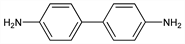
1077. Benzidine
Nomenclature
CAS number: 92-87-5
[1,1′-Biphenyl]-4,4′-diamine; p-diaminodiphenyl. C12H12N2; mol wt 184.24.
C 78.23%, H 6.56%, N 15.20%.
Description and references
Discovered by Zinin in 1845. Produced by reduction of nitrobenzene with Zn and NaOH; the resultant hydrazobenzene is heated with acid. Lab proc: A. I. Vogel, Practical Organic Chemistry (Longmans, London, 3rd ed., 1959) p 633; Gattermann-Wieland, Praxis des Organischen Chemikers (de Gruyter, Berlin, 40th ed., 1961) p 165. Review of carcinogenic risk: IARC Monographs 1, 80-86 (1972); ibid. 29, 149-183 (1982); M. Boeniger, Carcinogenicity and Metabolism of Azo Dyes, Especially Those Derived from Benzidine (DHHS/NIOSH 80-119, 1980) 141 pp. Review of toxicology and human exposure: Toxicological Profile for Benzidine (PB2001-109102, 2001) 242 pp.
Properties
White or slightly-reddish, cryst powder; darkens on exposure to air and light. Poisonous. mp 115-120° when slowly heated; 128° when anhydr and rapidly heated. bp ≈400°. Soly: one gram dissolves in 2500 ml cold, 107 ml boiling water, 5 ml boiling alcohol, 50 ml ether. Keep well closed and protected from light.Derivative
Dihydrochloride.C12H12N2.2HCl; mol wt 257.16.
C 56.05%, H 5.49%, N 10.89%, Cl 27.57%.