1241. α-Bisabolol
Nomenclature
Description and references
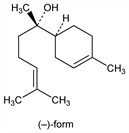
Fragrant sesquiterpene isolated from the essential oils of a variety of plants, shrubs and trees. Both isomers occur in nature; the (-)-form is the most widespread and is an active anti-inflammatory component of chamomile. The (+) and (-)-epi isomers are also naturally occurring. Isoln of (-)-form from Matricaria chamomilla: F. Sorm et al., Collect. Czech. Chem. Commun. 16, 626 (1951); of (+)-form from Populus balsamifera: idem et al., Chem. Listy 46, 364 (1952). Synthesis of racemic mixture: L. Ruzicka, M. Liguori, Helv. Chim. Acta 15, 3 (1932); C. D. Gutsche et al., Tetrahedron 24, 859 (1968). Enantioselective synthesis of (-)-form: H. Nemoto et al., Tetrahedron Lett. 34, 4939 (1993). Separation of four stereoisomers: K. Günther et al., Fresenius J. Anal. Chem. 345, 787 (1993). Pharmacology and toxicology of (-)-form: V. Jakovlev, A. von Schlichtegroll, Arzneim.-Forsch. 19, 615 (1969); S. Habersang et al., Planta Med. 37, 115 (1979). Comparative pharmacology of racemate and enantiomers: V. Jakovlev et al., ibid. 35, 125 (1979). Determn by HPLC in chamomile extracts: R. Herrmann, Dtsch. Apoth. Ztg. 36, 1797 (1982); by GC in cosmetic products: D. Andre et al., Int. J. Cosmet. Sci. 13, 137 (1991). Evaluation of use as dermal penetration enhancer: R. Kadir, B. W. Barry, Int. J. Pharm. 70, 87 (1991). Review of anti-inflammatory activity and use in cosmetics: N. Jellinek, Parfums Cosmet. Aromes 57, 55-57 (1984); of absolute configuration studies: G. W. O'Donnell, M. D. Sutherland, Aust. J. Chem. 42, 2021-2034 (1989).
Properties
bp12 155-157°. d423 0.9223. nD23 1.4917. Also reported as colorless oil, bp1.5 128-130° (Gutsche). Miscible with alcohols, oils and lipophilic substances.Derivative
(-)-Form.Nomenclature
Properties
bp12 153°. d20 0.9211. nD20 1.4936. [α]D -55.7°. Also reported as [α]D20 -51.02° (Günther). LD50 in mice, rats (mg/kg): 11350, 14850 orally (Jakovlev, von Schlichtegroll). LD50 in male, female mice, rats (ml/kg): 15.2, 15.0, 14.9, 15.6 orally (Habersang).Derivative
(+)-Form.Nomenclature
Properties
bp1.0 120-122°. d20 0.9213. nD20 1.4919. [α]D20 +51.7°. Also reported as [α]D20 +57.04° (Günther).Derivative
(-)-Epi-α-bisabolol.Nomenclature
Description and references
Isoln from Myoporum crassifolium: K. G. O'Brien et al., Aust. J. Chem. 6, 166 (1953).
Properties
[α]D20 -67.6°. Also reported as [α]D20 -67.48° (Günther).Derivative
(+)-Epi-α-bisabolol.Nomenclature
Description and references
Isoln from Salvia stenophylla: E. J. Brunke, F. J. Hammerschmidt, Proc. 15th Int. Symp. Essent. Oils Aromat. Plants 1985, 145.
Properties
[α]D20 +67.4°. Also reported as [α]D20 +70.11° (Günther).Use
In cosmetics.Therapeutic Category
Anti-inflammatory.
Keywords
Anti-inflammatory (Nonsteroidal)