1306. Bithionol
Nomenclature
CAS number: 97-18-7
2,2′-Thiobis[4,6-dichlorophenol]; TBP; bis(2-hydroxy-3,5-dichlorophenyl)sulfide; XL-7; Bithin; Lorothidol. C12H6Cl4O2S; mol wt 356.05.
C 40.48%, H 1.70%, Cl 39.83%, O 8.99%, S 9.01%.
Description and references
Prepn from 2,4-halo substituted phenol with S halides: Muth, DE 583055 (1933 to I. G. Farbenind.), C.A. 28, 179 (1934); Copper, Godfrey, US 2849494 (1958 to Monsanto). Comprehensive review and bibliography: Shumard et al., Soap Sanit. Chem. 29, no. 1, 34-37, 90 (1953). Anthelmintic activity of the sulfoxide: J. Guilhon, M. Graber, Bull. Acad. Vet. Fr. 52, 225 (1979). Metabolism of the sulfoxide in humans: M. Sakamoto et al., J. Toxicol. Sci. 6, 307 (1981).
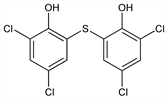
Properties
Crystals, mp 188°. d425 1.73. pK1 4.82; pK2 10.50. Vapor press. at 37°: 1.1 × 10⁻⁹ mm Hg. Practically insol in water (0.0004% at 25°). Sol in dil caustic solns. A 4% NaOH soln will dissolve 16.2% bithionol. Soly (g/100 ml): acetone 15.0; polysorbate 80 19.0; dimethylacetamide 72.5; lanolin at 42° 5.0; pine oil 4.0; corn oil 1.0; propylene glycol 0.5; 70% ethanol 0.3.Derivative
Sodium salt.Nomenclature
CAS number: 6385-58-6
Bithionolate sodium; Vancide BN (Vanderbilt). C12H4Cl4Na2O2S; mol wt 400.02.
C 36.03%, H 1.01%, Cl 35.45%, Na 11.49%, O 8.00%, S 8.02%.
Description and references
Harvey et al., US 3024163 (1962 to Vanderbilt Co.).
Derivative
Sulfoxide.Nomenclature
BTS; Bitin-S (Tanabe Seiyaku); Disto-5 (Cogla).C12H6Cl4O3S; mol wt 372.05.
C 38.74%, H 1.63%, Cl 38.12%, O 12.90%, S 8.62%.
Use
Surfactant-formulated antimicrobial against bacteria, molds and yeast. In cosmetics. Proposed as agricultural fungicide.Therapeutic Category
Anti-infective (topical).
Therapeutic Category (Veterinary)
Anthelmintic; antiseptic.Keywords
Antiseptic/Disinfectant; Phenols