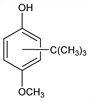
1547. Butylated Hydroxyanisole
Nomenclature
CAS number: 25013-16-5
(1,1-Dimethylethyl)-4-methoxyphenol; 2(3)-tert-butyl-4-hydroxyanisole; BHA; Antrancine 12 (Jandekker); Embanox; Nipantiox 1-F (Nipa); Sustane 1-F (UOP); Tenox BHA (Eastman Kodak). C11H16O2; mol wt 180.24.
C 73.30%, H 8.95%, O 17.75%.
Description and references
A mixture of 2-tert-butyl-4-methoxyphenol (also called 3-tert-butyl-4-hydroxyanisole) and 3-tert-butyl-4-methoxyphenol (also called 2-tert-butyl-4-hydroxyanisole). Prepn from p-methoxyphenol and isobutene: R. H. Rosenwald, US 2459540; US 2470902 (both 1949 to Universal Oil Products). Toxicity study: A. J. Lehman et al., Adv. Food Res. 3, 197 (1951). Review of carcinogenic risk: IARC Monographs 40, 123-159 (1986); antimicrobial activity: M. Riccach, J. Food Saf. 6, 141-170 (1984); of physicochemical properties, antioxidant activity and toxicology: H. Verhagen et al., Chem. Biol. Interact. 80, 109-134 (1991); of safety assessment as food additive: G. M. Williams et al., Food Chem. Toxicol. 37, 1027-1038 (1999).