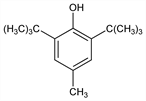
1548. Butylated Hydroxytoluene
Nomenclature
CAS number: 128-37-0
2,6-Bis(1,1-dimethylethyl)-4-methylphenol; 2,6-di-tert-butyl-p-cresol; 2,6-di-tert-butyl-4-methylphenol; BHT; Antrancine 8 (Jandekker); Tenox BHT (Eastman Kodak); Ionol CP (Shell); Sustane (UOP); Dalpac; Impruvol; Vianol. C15H24O; mol wt 220.35.
C 81.76%, H 10.98%, O 7.26%.
Description and references
Prepn from p-cresol and isobutylene: Stillson, US 2428745 (1947 to Gulf); McConnell, Davis, US 3082258 (1963 to Eastman Kodak). Toxicity study: W. A. McOmie et al., J. Am. Pharm. Assoc. 38, 366 (1949). Review of physicochemical properties, antioxidant activity and toxicology: H. Babich, Environ. Res. 29, 1-29 (1982); of antimicrobial activity: M. Raccach, J. Food Saf. 6, 141-170 (1984); of safety assessment as food additive: G. M. Williams et al., Food Chem. Toxicol. 37, 1027-1038 (1999).