1732. Camphor
Nomenclature
Description and references
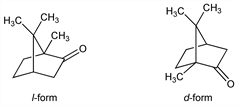
Naturally occuring in both the d- and l-forms; orginally obtained commercially as the d-form from the camphor tree, Cinnamomum camphora T. Nees & Ebermeier, Lauraceae. Primarily manufactured from pinene as the racemate. History of isolation and production of natural and synthetic forms: I. Gubelmann, H. W. Elley, Ind. Eng. Chem. 26, 589 (1934); J. M. Derfer, M. M. Derfer in Kirk-Othmer Encyclopedia of Chemical Technology vol. 23 (John Wiley & Sons, New York, 4th ed., 1997) pp 865-866. Enantiomeric composition in oils of coriander, sage, and basil: F. Tateo et al., Anal. Commun. 36, 149 (1999). GC determn in human plasma: J. S. Valdez et al., J. Chromatogr. B 729, 163 (1999); in pharmaceutical formulation: E. Gonzálea-Penas et al., Chromatographia 52, 245 (2000). Review: Camphor and Camphor Containing Products (PB293503, 1979) 65 pp; J. S. Mossa, M. M. A. Hassan, Anal. Profiles Drug Subs. 13, 28-93 (1984). Review of use as starting material for syntheses: T. Money, Org. Synth. 3, 1-83 (1996).
Properties
White or colorless crystals or crystalline masses; also colorless to white translucent masses. Characteristic fragrant and penetrating odor. Pungent, aromatic taste. d425 0.992. mp 179°. bp101.3 kPa 209°. Volatilizes slowly. uv max (CHCl3): 292 nm. Flammable. At 25° one gram dissolves in about 800 ml water, in 1 ml alcohol, 1 ml ether, 0.5 ml chloroform. Freely sol in carbon disulfide, petr. benzin, fixed and volatile oils. Also sol in concd mineral acids, in phenol, in liquid NH3 and in liquid SO2. LD50 orally in mice: 1.3 g/kg (PB293505).Derivative
d-Form.Nomenclature
Properties
Colorless, transparent crystals, mp 179.8°, sublimes 204°. [α]D25 +41 to +43° (c = 10 in U.S.P. alcohol) according to U.S.P. specif.Derivative
l-Form.Nomenclature
Derivative
Spirit of Camphor.Description and references
A soln of camphor in alcohol contg 10 g camphor per 100 ml soln.
Properties
Colorless liquid; camphor odor.Caution
Potential symptoms of overexposure to synthetic camphor are irritation of eyes, skin, mucous membranes; nausea, vomiting, diarrhea; headache, dizziness, confusion, vertigo, excitement, restlessness, delerium, hallucinations; epileptic convulsions; CNS depression, coma. See NIOSH Pocket Guide to Chemical Hazards (DHHS/NIOSH 97-140, 1997) p 48; Clinical Toxicology of Commercial Products, R. E. Gosselin et al., Eds. (Williams & Wilkins, Baltimore, 5th ed., 1984) Section III, pp 84-86.Use
Starting reagent for organic syntheses. Used as an odorant and flavorant and as a moth repellant. Plasticizer in cosmetics and as a preservative.Therapeutic Category
Topical analgesic; topical antipruritic.
Therapeutic Category (Veterinary)
Has been used internally as a stimulant and carminative; externally as an antipruritic, counterirritant and antiseptic.Keywords
Antipruritic