1843. Carminic Acid
Nomenclature
CAS number: 1260-17-9
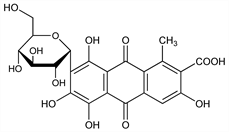
7-α-d-Glucopyranosyl-9,10-dihydro-3,5,6,8-tetrahydroxy-1-methyl-9,10-dioxo-2-anthracenecarboxylic
acid; C.I. Natural Red 4; C.I. 75470. C22H20O13; mol wt 492.39.
C 53.66%, H 4.09%, O 42.24%.
Description and references
Glucosidal coloring matter from the scale insect Coccus cacti L., Homoptera (cochineal). The essential constituent of carmine. Isoln: Schunk, Marchlewski, Ber. 27, 2979 (1894); Dimroth, Scheuer, Ann. 399, 43 (1913). Structure: Dimroth, Kammerer, Ber. 53, 471 (1920); Ali, Haynes, J. Chem. Soc. 1959, 1033; revised structure: Bhatia, Venkataraman, Indian J. Chem. 3 (2), 92 (1965). See also Colour Index vol. 4 (3rd ed., 1971) p 4632.
Properties
Red prisms from alc, no distinct melting point, darkens at 120°. Has a deep red color in water and is yellow to violet in acid solns. uv max (water): 500 nm (ε 6800); (0.02N HCl): 490-500 nm (ε 5800); (0.0001N NaOH): 540 nm (ε 3450). [α]15654 +51.6° (water). Sol in water, alc, concd H2SO4; slightly sol in ether. Practically insol in petr ether, benzene, chloroform.Derivative
Methyl tetra-O-methylcarminate.C27H30O13; mol wt 562.52.
C 57.65%, H 5.38%, O 36.98%.