2142. Chlorogenic Acid
Nomenclature
CAS number: 327-97-9
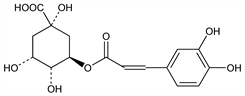
[1S-(1α,3β,4α,5α)]-3-[[3-(3,4-Dihydroxyphenyl)-1-oxo-2-propenyl]oxy]-1,4,5-trihydroxycyclohexanecarboxylic
acid; 1,3,4,5-tetrahydroxycyclohexanecarboxylic acid 3-(3,4-dihydroxycinnamate); 3-caffeoylquinic acid; 3-(3,4-dihydroxycinnamoyl)quinic acid. C16H18O9; mol wt 354.31.
C 54.24%, H 5.12%, O 40.64%.
Description and references
Important factor in plant metabolism. Isoln from green coffee beans: Freudenberg, Ber. 53, 237 (1920). Chlorogenic acid and its isomers isochlorogenic acid and neochlorogenic acid occur also in fruit, leaves and other tissues of dicotyledenous plants: Sondheimer, Arch. Pharm. 293, 721 (1960). Forms caffeic acid on hydrolysis: Fiedler, Arzneim.-Forsch. 4, 41 (1954). Structure: Fischer, Dangschat, Ber. 65, 1037 (1932); Barnes et al., J. Am. Chem. Soc. 72, 4178 (1950); Corse et al., Tetrahedron 18, 1207 (1962). Synthesis: Panizzi et al., Gazz. Chim. Ital. 86, 913 (1956).
Derivative
Hemihydrate.Properties
Needles from water. Becomes anhydr at 110°. mp 208°. [α]D26 -35.2° (c = 2.8). pKa (27°) 2.66. Rf values: Fiedler, loc. cit. Soly in water at 25° about 4%, much more sol in hot water. Alkaline solns acquire an orange color. Freely sol in alcohol, acetone. Very slightly sol in ethyl acetate. Heating with dil HCl yields caffeic acid. Forms a black compd with iron, said to be responsible for the blackening of cut and cooked potatoes: Chem. Ind. (London) 1958, 627.Derivative
3′-Methyl ether.Nomenclature
3-Feruloylquinic acid.C17H20O9; mol wt 368.34.
C 55.43%, H 5.47%, O 39.09%.