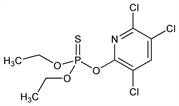
2189. Chlorpyrifos
Nomenclature
CAS number: 2921-88-2
Phosphorothioic acid O,O-diethyl O-(3,5,6-trichloro-2-pyridinyl)
ester; O,O-diethyl O-3,5,6-trichloro-2-pyridyl
phosphorothioate; chlorpyrifos-ethyl; Dowco 179; ENT-27311; Affront (Wellmark); Dursban (Dow AgroSci.); Empire (Dow AgroSci.); Lock-On (Dow AgroSci.); Lorsban (Dow AgroSci.); Pyrinex (Makhteshim-Agan). C9H11Cl3NO3PS; mol wt 350.59.
C 30.83%, H 3.16%, Cl 30.34%, N 4.00%, O 13.69%, P 8.83%, S
9.15%.
Description and references
Prepn: R. H. Rigterink, FR 1360901; idem, US 3244586 (1964, 1966 both to Dow); R. H. Rigterink, E. E. Kenaga, J. Agric. Food Chem. 14, 394 (1966). Activity: E. E. Kenaga et al., J. Econ. Entomol. 58, 1043 (1965). Metabolism: G. N. Smith et al., J. Agric. Food Chem. 15, 132 (1967); W. H. Gutenmann et al., ibid. 16, 45 (1968). Toxicity study: Schafer, Toxicol. Appl. Pharmacol. 21, 315 (1972). Review of environmental fate: K. D. Racke, Rev. Environ. Contam. Toxicol. 131, 1-154 (1993); of toxicology and human exposure: Toxicological Profile for Chlorpyrifos (PB98-103088, 1997) 217 pp.
Properties
White granular crystals, mp 41-42°. Vapor pressure at 25°: 1.87 × 10⁻⁵ mm Hg. Soly at 25°: water 2 ppm; isooctane 79% w/w; methanol 43% w/w. Soly (g/100g): acetone 650, benzene 790, carbon disulfide 590, carbon tetrachloride 310, chloroform 630, diethyl ether 510, ethanol 63, ethyl acetate >200, isooctane 79, kerosene 60, methanol 45, methylene chloride 400, propylene glycol 4, toluene 150, 1,1,1-trichloroethane 400, triethylene glycol 5, xylene 400. Readily sol in other org solvents. uv max: 208, 230, 290 nm. LD50 orally in rats: 145 mg/kg (Schafer).Derivative
O,O-Dimethyl analog.Nomenclature
CAS number: 5598-13-0
Chlorpyrifos-methyl; Dowco 214; ENT-27520; Reldan (Dow AgroSci.). C7H7Cl3NO3PS; mol wt 322.53.
C 26.07%, H 2.19%, Cl 32.98%, N 4.34%, O 14.88%, P 9.60%, S
9.94%.