2253. Chrysarobin
Nomenclature
Description and references
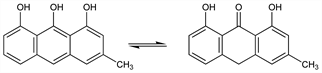
Improperly called “medicinal chrysophanic acid”. The name chrysarobin today has two meanings: (1) A commercial product consisting of 70-85% of different anthraquinone derivs extracted from Goa powder (Araroba); (2) A pure substance, (1,8-dihydroxy-3-methyl-9-anthrone; 3-methyl-1,8,9-anthracenetriol), reduction product of chrysophanic acid, q.v. This pure substance constitutes about 30% of commercial chrysarobin. Isoln of the commercial product from the wood of Andira araroba Aguiar [Vouacapoua araroba (Aguiar) Lyons], Leguminosae: Liebermann, Siedler, Ann. 212, 29 (1882); Hesse; ibid. 309, 53 (1899). Prepn of the pure substance by reduction of chrysophanic acid: Naylor, Gardner, J. Am. Chem. Soc. 53, 4114 (1931).
Properties
Commercial product, brownish to orange-yellow, microcrystalline, odorless, tasteless powder. Irritating to mucous membranes; causes dangerous inflammation if it enters the eye. Very slightly sol in water; 1 g dissolves in 385 ml alcohol, 30 ml benzene, 15 ml chloroform, 160 ml ether, 180 ml carbon disulfide; also sol in fats. Dissolves in alkali hydroxides or in H2SO4 with a red color and is pptd from the H2SO4 soln by diluting with H2O.Derivative
Pure substance.Nomenclature
Properties
Yellow needles from glacial acetic acid, mp 203.4-204°.Caution
Ingestion may cause renal damage, severe gastroenteritis. Application to large areas of skin may cause renal irritation by percutaneous absorption. Inadvertent conjunctival contact frequently produces conjunctivitis. Allergic reaction of skin has been reported.Therapeutic Category
Has been used as antipsoriatic.
Therapeutic Category (Veterinary)
Has been used in ringworm, and noninfectious diseases of the skin.Keywords
Antipsoriatic