2723. Cyclohexane
Nomenclature
Description and references
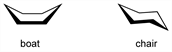
Occurs in petr (0.5-1.0%). Obtained in the distillation of petr or by hydrogenation of benzene. In the distillation of petr the C4-400°F boiling range naphthas are fractionated to obtain a C5-200°F naphtha contg 10-14% cyclohexane which on superfractionation yields an 85% concentrate (which is sold as such); further purification necessitates isomerization of pentanes to cyclohexane, heat cracking for removing open chain hydrocarbons and sulfuric acid treatment to remove aromatic compds. The hydrogenation of benzene is done in the liq phase at 150° using Raney nickel catalyst and at least 10 atm H2 pressure: Sabatier, Ind. Eng. Chem. 18, 1005 (1926). Review and bibliography: Sachanen, Chemical Constituents of Petroleum (New York, 1945). Prepn of high purity cyclohexane: Seyer et al., Ind. Eng. Chem. 31, 759 (1939). Cyclohexane can exist in two interconvertible conformations, the boat and the chair. In the chair form its 12 extracyclic bonds fall into two classes: six lie parallel to the main axis of symmetry and are designated “axial”, while six extend radially outward at ±109.5° angles to the axis and are designated as “equatorial”, Barton et al., Nature 172, 1096 (1954); Science 119, 49 (1954). Solubility: F. P. Schwarz, Anal. Chem. 52, 10 (1980). Toxicity: Lazarew, Arch. Exp. Pathol. Pharmakol. 143, 223 (1929). Physical properties and methods of purification: L. Scheflan, M. B. Jacobs, The Handbook of Organic Solvents (Van Nostrand, 1953) p 233; Techniques of Chemistry vol. II, entitled “Organic Solvents”, J. D. Riddick, W. B. Bunger, Eds. (Wiley-Interscience, New York, 3rd ed., 1970) p 592. Review: M. L. Campbell in Kirk-Othmer Encyclopedia of Chemical Technology vol. 12 (Wiley-Interscience, New York, 3rd ed., 1980) pp 931-937.