Nomenclature
CAS number: 91-17-8
Decahydronaphthalene; perhydronaphthalene; bicyclo[4.4.0]decane; naphthalane; naphthane; DeKalin.
C
10H
18; mol wt 138.25.
C 86.88%, H 13.12%.
Description and references
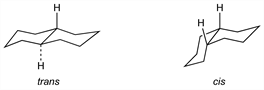
Occurs in two forms: cis and trans. Hydrogenation of naphthalene in glacial acetic acid
in the presence of platinum catalyst at 25° and 130 atm yields a mixture
of 77% cis-Decalin and 23% trans-Decalin. Hydrogenation
of Tetralin under the same conditions yields almost only cis-Decalin: Baker, Schuetz, J. Am. Chem. Soc. 69, 1250 (1947). Hydrogenation of Δ4a(8a)-octalin in ethanol in the presence of platinum yields trans-Decalin as the main component: Linstead et al., J. Chem. Soc. 1937, 1136. Separation
of trans- and cis-forms: Seyer, Walker, J. Am. Chem. Soc. 60, 2125 (1938).
Prepn of trans-Decalin from cis-Decalin: Zelinsky, Ber. 65, 1299 (1932). Conformation
studies: Barton, J. Chem. Soc. 1948, 340; Moniz, Dixon, J. Am.
Chem. Soc. 83, 1671 (1961). Toxicity data:
Smyth et al., Arch. Ind. Hyg.
Occup. Med. 4, 119 (1951).
Properties
Liquid. Slight odor resembling menthol. Pure
Decalin does not smell of naphthalene. Volatile with steam. The
commercial product may be practically all trans-Decalin,
or a mixture contg up to 60% cis-Decalin. The commercial
mixture has a flash pt (closed
cup) of about 136°F (58°C). Autoignition temp 504°F.
Insol in water. Very sol in alcohol, methanol, ether, chloroform.
Miscible with propyl and isopropyl alcohol; miscible with most ketones
and esters. LD50 orally in rats: 4.2 g/kg; LC (in air) in rats: 500 ppm (Smyth).Derivative
cis-Form.
Properties
mp -43.26°. bp 195.7°; bp9 67.0°. d420 0.8963. nD20 1.48113.Derivative
trans-Form.
Properties
mp -30.4°. bp 187.25°; bp9 62.0°. d420 0.8700. nD20 1.46968.Use
Solvent for naphthalene, fats, resins, oils, waxes;
used instead of turpentine in lacquers, shoe polishes, floor waxes.
In motor fuel and lubricants. As patent fuel in stoves.