2938. Detoxin Complex
Nomenclature
DX.C.Description and references
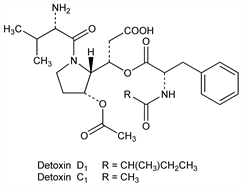
A group of selective antagonists of blasticidin S, q.v., produced by Streptomyces caespitosus var. detoxicus 7072 GC1. The complex counteracts the inhibitory action of blasticidin S (BS) against Bacillus cereus but not against Piricularia oryzal, the causative agent of rice blast disease. DX.C also depresses the phytotoxicity of BS to rice plants, and a combination of the two showed less eye irritation in animals than BS alone. Isoln, production, biological properties: H. Yonehara et al., J. Antibiot. 21, 369 (1968); eidem, Agric. Biol. Chem. 37, 2771 (1973). Separation of the complex yields eight groups of detoxins designated A through H, the major components being C and D: N. Otake et al., J. Antibiot. 21, 371 (1968); eidem, Agric. Biol. Chem. 37, 2777 (1973). Detoxin D1, the major component of the D group, has been shown to have the highest specific activity. It is a unique depsipeptide containing the amino acid detoxinine (β,3-dihydroxy-2-pyrrolidinepropanoic acid). Structure of D1: K. Kakenuma et al., Tetrahedron Lett. 1972, 2509. 13C-NMR: T. Ogita et al., Agric. Biol. Chem. 42, 2403 (1978). Structures of the minor components of the D group: N. Otake et al., J. Antibiot. 27, 484 (1974). Structures of detoxins A1, B1, B3, C1, C2, C3, E1: N. Otake et al., Experientia 37, 926 (1981); T. Ogita et al., Agric. Biol. Chem. 45, 2605 (1981). Effect of D on BS uptake in B. cereus: A. Shimazu et al., Experientia 37, 365 (1981).