3491. Ecdysteroids
Description and references
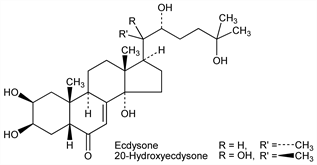
Polyhydroxylated steroids formerly known as ecdysones. Originally identified as insect molting hormones controlling the pupation of insects. Later shown to be involved in many complex developmental processes in metamorphosis, differentiation and reproduction. Ecdysteroids have been detected in invertebrate species of several phylla belonging to the Protostomia and in some plant species. The terms zooecdysteroids and phytoecdysteroids are used to distinguish ecdysteroids isolated from animal species from those of plant origin. Nomenclature: T. W. Goodwin et al., Nature 272, 122 (1978). The two major ecdysteroids isolated are ecdysone and 20-hydroxyecdysone. Configuration: M. Koreeda et al., J. Am. Chem. Soc. 93, 4084 (1971). Chromosomal action: M. Ashburner, Nature 285, 435 (1980). GC and HPLC determn: R. P. Evershed et al., J. Chromatogr. 390, 357 (1987). Reviews: Kilby, Discovery 18, 13 (1957); P. Karlson, Angew. Chem. Int. Ed. 2, 175-182 (1963); K. Nakanishi, Pure Appl. Chem. 25, 167-195 (1971); M. Koreeda, B. A. Teicher, Anal. Biochem. Insects 1977, 207-240; P. Karlson, Dev. Endocrinol. 7, 1-11 (1980). Book: Ecdysone: From Chemistry to Mode of Action, J. Koolman, Ed. (Thieme, New York, 1989) 482 pp.
Derivative
Ecdysone.Nomenclature
Description and references
Secreted by ecdysial tissues, then transformed to more active compound, 20-hydroxyecdysone. First isoln from silkworm moths, Bombyx mori: A. Butenandt, P. Karlson, Z. Naturforsch. 9b, 389 (1954). Isoln from rhizomes of Polypodium vulgare L.: G. Heinrich, H. Hoffmeister, Experientia 23, 995 (1967); from bracken fern, Pteridinium aquilinum: J. N. Kaplanis et al., Science 157, 1436 (1967). Structure: P. Karlson et al., Ber. 98, 2394 (1965). Configuration: R. Huber, W. Hoppe, ibid. 2403. Synthesis: U. Kerb et al., Helv. Chim. Acta 49, 1601 (1966); J. B. Siddall et al., J. Am. Chem. Soc. 88, 379, 862 (1966); H. Mori et al., Chem. Pharm. Bull. 16, 563 (1968).
Properties
mp 238-239°. [α]20578 +62°. uv max: 243 nm (ε 11600).Derivative
20-Hydroxyecdysone.Nomenclature
Description and references
Most widely occurring ecdysteroid in both plant and animal species. Isoln from B. mori: P. Hocks, R. Wiechert, Tetrahedron Lett. 1966, 2989; from seawater crayfish, Jasus lalandei: F. Hampshire, D. H. S. Horn, Chem. Commun. 1966, 37. Isolns from plant sources, Achyranthes fauriei: T. Takemoto et al., Yakugaku Zasshi 87, 325 (1967); P. elatus: M. N. Galbraith, D. H. S. Horn, Chem. Commun. 1966, 905; P. vulgare: J. Jizba et al., Tetrahedron Lett. 1967, 1689. Isoln from parasitic helminths: H. H. Rees, J. G. Mercer, Adv. Invertebr. Reprod. 4, 173 (1986). Configuration: Dammeier, Hoppe, Ber. 104, 1660 (1971). Synthesis: G. Hüppi, J. B. Siddall, J. Am. Chem. Soc. 89, 6790 (1967); U. Kerb et al., Tetrahedron Lett. 1968, 4277; H. Mori, K. Shibata, Chem. Pharm. Bull. 17, 1970 (1969). Total synthesis: T. Kametani et al., Tetrahedron Lett. 21, 4855 (1980).