3559. Emetine
Nomenclature
Description and references
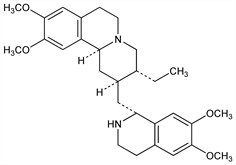
Principal alkaloid of ipecac, the ground roots of Uragoga ipecacuanha (Brot.) Baill. Rubiaceae; occurs naturally as (-)-form. Extraction procedures: E. Merck, BIOS Final Report No. 766 (1947); F. E. Hamerslag, Technology and Chemistry of Alkaloids (New York, 1950) chapter XI; Stoll, Jucker in Ullmanns Encyklop"adie der technischen Chemie 3, Aufl., Bd. III (München-Berlin, 1953) p 231; Beilstein 2nd suppl. vol. 23, 449. Structure: Robinson, Nature 162, 524 (1948); Janot, Bull. Soc. Chim. Fr. 1949, 185. Stereochemistry: Battersby, Chem. Ind. (London) 1958, 1324; Battersby, Garrett, J. Chem. Soc. 1959, 3512; Van Tamelen et al., J. Am. Chem. Soc. 81, 6214 (1959). Total synthesis: Evstigneeva et al., Proc. Acad. Sci. USSR 75, 539 (1950); Van Tamelen et al., J. Am. Chem. Soc. 91, 7359 (1969); T. Kametani et al., J. Chem. Soc. Perkin Trans. 1 1979, 1211. Alternate syntheses: Burgstahler, Bithos, J. Am. Chem. Soc. 82, 5446 (1960); Openshaw, Whittaker, J. Chem. Soc. 1963, 1461; S. Takano et al., J. Org. Chem. 43, 4169 (1978); T. Fujii, S. Yoshifuji, Tetrahedron 36, 1539 (1980). See also Clark et al., US 3102118 (1963 to Glaxo). Review of syntheses: M. Shamma, The Isoquinoline Alkaloids (Academic Press, New York, 1972) pp 426-457. Toxicity: Radomski et al., J. Pharmacol. Exp. Ther. 104, 421 (1952); of dihydrochloride: Child et al., J. Pharm. Pharmacol. 16, 65 (1964). General review: Grollman, Jarkovsky, in Antibiotics Vol. 3, J. W. Corcoran, F. E. Hahn, Eds. (Springer-Verlag, New York, 1975) pp 420-435. Comprehensive description: L. V. Feyns, L. T. Grady, Anal. Profiles Drug Subs. 10, 289-335 (1981).
Properties
White, amorphous powder. mp 74°. Turns yellow on exposure to light and heat. [α]D20 -50° (c = 2 in CHCl3). Strong alkaline reaction. pK1 5.77; pK2 6.64. Freely sol in methanol, ethanol, acetone, ethyl acetate, ether, chloroform. Sparingly sol in water, petr ether. Moderately sol in dil ammonium hydroxide, but sparingly in solns of KOH and NaOH. Absorption spectrum: Bayard, Chem. Zentralbl. 1943, II, 305. LD50 i.p. in rats: 12.1 mg/kg (Radomski).Derivative
Dihydrochloride.Nomenclature
Properties
Contains water of crystallization varying from 3 to 8 H2O. Clusters of needles after drying at 105°, mp 235-255° (dec). [α]D +11° (c = 1) to [α]D +21° (c = 8), calculated for the anhydrous salt. One gram of the hydrated salt dissolves in about 7 ml water. pH of aq soln (1 g in 50 ml) 5.6. Sol in alcohol. Solid and solutions turn yellow on exposure to light or heat. LD50 (calculated as base) in mice (mg/kg): 32 s.c.; 30 orally (Child).Derivative
Emetamine.Nomenclature
Description and references
Occurs in small amounts in ipecac. Isoln: Pyman, J. Chem. Soc. 111, 419 (1917). Structure: Battersby et al., J. Chem. Soc. 1959, 1744. Synthesis: eidem, J. Chem. Soc. 1961, 3899.
Properties
Crystals from ether, mp 142-143°. uv max (ethanol): 236, 283 nm (log ε 4.85, 3.86).Therapeutic Category
Antiamebic.
Therapeutic Category (Veterinary)
Hydrochloride has been used as an antiamebic and in lung worm infection.Keywords
Antiamebic