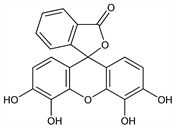
4344. Gallein
Nomenclature
CAS number: 2103-64-2
3′,4′,5′,6′-Tetrahydroxyspiro[isobenzofuran-1(3H),9′-[9H]xanthen]-3-one; 3′,4′,5′,6′-tetrahydroxyfluoran; 3′,4′,5′,6′-tetrahydroxyspiro[phthalan-1,9′-xanthen]-3-one; pyrogallolphthalein; C.I. 45445; mordant violet 25. C20H12O7; mol wt 364.31.
C 65.94%, H 3.32%, O 30.74%.
Description and references
Obtained by heating 1 part phthalic anhydride with 2 parts of pyrogallol or gallic acid: Baeyer, Ber. 4, 457 (1871); Buchka, Ann. 209, 261 (1881). Use as a biological stain: R. D. Lillie et al., Stain Technol. 49, 339 (1974); R. Welsh, ibid. 52, 261 (1977). See also H. J. Conn's Biological Stains, R. D. Lillie, Ed. (Williams & Wilkins, Baltimore, 9th ed., 1977) p 351.
Properties
Brownish-red powder or crystals with 1 H2O, or red crystals with greenish-yellow color when anhydr. Loses the water of crystn at about 180° and blackens above this temp. Does not melt even at 300°. pH 3.8 brownish-yellow; pH 6.6 rose-red. Almost insol in water, benzene, chloroform. Slightly sol in ether; sol in alc, acetone, alkalies.Derivative
Disodium salt.Nomenclature
Alizarin violet.C20H10Na2O7; mol wt 408.27.
C 58.84%, H 2.47%, Na 11.26%, O 27.43%.