4345. Gallic Acid
Nomenclature
Description and references
Obtained by alkaline or acid hydrolysis of the tannins from nutgalls; also by enzymatic hydrolysis using spent broths from Penicillium glaucum or Aspergillus niger which contain tannase: A. G. Perkin, O. Gunnell, J. Chem. Soc. 69, 1303 (1896); Hsias, Huang Hai No. 7, 51 (1946), C.A. 42, 3901i (1948); Cochrane, Econ. Bot. 2, 145 (1948); Toth, Henster, Acta Chim. Acad. Sci. Hung. 2, 209 (1952). Prepn from tannin containing materials: Krueger et al., US 2723992 (1955 to Mallinckrodt). Synthesis from aliphatic materials: Shipchandler et al., J. Chem. Soc. Perkin Trans. 1 1975, 1400. Biosynthesis: Haslam et al., J. Chem. Soc. 1961, 1854. Study of polymorphic forms: E. Lindpainter, Mikrochemie 27, 21 (1939). Toxicity studies: J. W. Dollahite et al., Am. J. Vet. Res. 23, 1264 (1962).
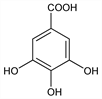
Properties
Needles from abs methanol or chloroform, formerly reported as dec 235-240° (Perkin, Gunnell). Sublimes at 210° giving a stable form with mp 258-265° (dec) and an unstable form mp 225-230° (Lindpainter). One gram dissolves in 87 ml water, 3 ml boiling water, 6 ml alcohol, 100 ml ether, 10 ml glycerol, 5 ml acetone. Practically insol in benzene, chloroform, petr ether. Protect from light. LD50 in rabbits (g/kg): 5.0 orally (Dollahite).Derivative
Monohydrate.Nomenclature
Derivative
Methyl ester.Nomenclature
Properties
Monoclinic prisms from methanol, often hydrated or solvated. When dry, mp 202°. Sol in hot water, alcohol, methanol, ether.Derivative
Propyl ester see Propyl Gallate.Use
Manuf gallic acid esters, pyrogallol, inks; as photographic developer; in tanning; in dyeing; in testing for free mineral acids, dihydroxyacetone, and alkaloids. Esters as antioxidants.Therapeutic Category
Formerly as astringent, styptic.
Therapeutic Category (Veterinary)
Has been used as intestinal astringent.Keywords
Astringent