4395. Gentian Violet
Nomenclature
CAS number: 548-62-9
N-[4-[Bis[4-(dimethylamino)phenyl]methylene]-2,5-cyclohexadien-1-ylidene]-N-methylmethanaminium chloride (1:1); C.I. Basic Violet 3; hexamethylpararosaniline chloride; hexamethyl-p-rosaniline chloride; aniline violet; crystal violet; methylrosanilinium chloride; C.I. 42555; Axuris (Fournier); Badil (Bayer); Gentiaverm (Berlin-Chemie); Pyoktanin (Merck KGaA). C25H30ClN3; mol wt 407.98.
C 73.60%, H 7.41%, Cl 8.69%, N 10.30%.
Description and references
Prepn and properties: Colour Index vol. 4 (3rd ed., 1971) p 4391. Toxicity studies: H. C. Hodge et al., Toxicol. Appl. Pharmacol. 22, 1 (1972). Review of metabolism and mode of action: R. Docampo, S. N. Moreno, Drug Metab. Rev. 22, 161-178 (1990); of use as a biological stain: Conn's Biological Stains, R. W. Horobin, J. A. Kiernan, Eds. (BIOS Scientific Publishers Ltd, Oxford, UK, 10th ed., 2002) 193-195.
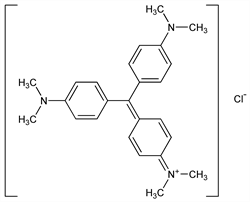
Properties
Dark green powder or greenish, glistening pieces with metallic luster. Soly (%): water 0.2-1.7; ethanol 3-14; acetone 0.4; chloroform 5.1. Insol in xylene. Absorption max (water): 590 nm. Changes from yellow at pH 0.0 to blue-violet at pH 2.0. LD50 orally in mice, rats: 1.2, 1.0 g/kg (Hodge).Note
Commercial product, which is usually admixed with pentamethylpararosaniline chloride and tetramethylpararosaniline chloride, contains not less than 96% gentian violet.Use
As dye for wood, silk, paper; in inks. Biological stain for bacterial components, vascular plant tissues, amyloid, etc. Used in Gram stain. As addition to microbiological culture media. Indicator for copper salts. Used to quench autofluorescence.Therapeutic Category
Anti-infective (topical). Has been used as anthelmintic (Nematodes). Blood additive to prevent transmission of Chagas' disease by blood transfusion.
Therapeutic Category (Veterinary)
Antimicrobial (topical); mycostatic agent in poultry feed.Keywords
Anthelmintic (Nematodes); Antiseptic/Disinfectant; Dyes