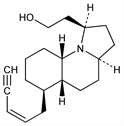
4402. Gephyrotoxin
Nomenclature
Description and references
Parent member of a class of tricyclic perhydrobenzoindolizine neurotoxin alkaloids isolated from the skin secretions of the Colombian poison-dart frogs Dendrobates histrionicus and Dendrobates occultator, family Dendrobatidae. The name gephyrotoxin was coined from the Greek word “gephyra” meaning “bridge”, and refers to the bridge presumably formed by addition of the nitrogen function to one side of a 2,6-disubstituted piperidine precursor to form the bicyclic indolizine. Isolation of naturally occurring l-form: T. Tokuyama et al., Helv. Chim. Acta 57, 2597 (1974). Structure and absolute configuration: J. W. Daly et al., ibid. 60, 1128 (1977). Revised configuration: R. Fujimoto, Y. Kishi, Tetrahedron Lett. 1981, 4197. Total synthesis of (±)-form: R. Fujimoto et al., J. Am. Chem. Soc. 102, 7154 (1980); D. J. Hart, J. Org. Chem. 46, 3576 (1981); D. J. Hart, K. Kanai, J. Am. Chem. Soc. 105, 1255 (1983); L. E. Overman et al., ibid. 5373. Complete proton and 13C NMR assignment: M. W. Edwards, A. Bax, ibid. 108, 918 (1986). Effect on neuromuscular transmission: C. Souccar et al., Mol. Pharmacol. 25, 384, 395 (1984). Receptor binding study: R. S. Aronstam et al., Neurochem. Res. 11, 1227 (1986). Review including discussion of gephyrotoxin congeners: J. W. Daly, Fortschr. Chem. Org. Naturst. 41, 283-300 (see also refs pp 326-340) (1982).