4469. Glutamic Acid
Nomenclature
Description and references
Non-essential amino acid for human development; referred to as an excitatory amino acid (EAA) due to its role in neurotransmission. Isoln from wheat gluten: H. Ritthausen, J. Prakt. Chem. 99, 454 (1866). Early chemistry and biochemistry: Amino Acids and Proteins, D. M. Greenberg, Ed. (Charles C. Thomas, Springfield, IL, 1951) 950 pp., passim; J. P. Greenstein, M. Winitz, Chemistry of the Amino Acids vols 1-3 (John Wiley and Sons, Inc., New York, 1961) pp. 1929-1954, passim; C. W. Huffman, W. G. Skelly, Chem. Rev. 63, 625-644 (1963). Interconversion from l-proline: S. Yoshifuji et al., Tetrahedron Lett. 21, 2963 (1980). Determn in serum: C. D. Stalikas et al., Eur. J. Clin. Chem. 32, 767 (1994); of naturally occurring levels in food: D. H. Daniels et al., Food Addit. Contam. 12, 21 (1995). Identification as excitatory neurotransmitter: D. R. Curtis et al., J. Physiol. 150, 656 (1960). Review of biosynthesis: A. Hamberger et al., Adv. Biochem. Psychopharmacol. 27, 115-126 (1981); of metabolism and associated disorders: S. B. Prusiner, Annu. Rev. Med. 32, 521-542 (1981). Review of receptor binding: P. A. Briley et al., Mol. Cell. Biochem. 39, 347 (1981). Review as neurotransmitter: B. Engelsen, Acta Neurol. Scand. 74, 337-355 (1986); E. Marmo, Med. Res. Rev. 8, 441-458 (1988). Review of role in learning and memory: W. J. McEntee, T. H. Crook, Psychopharmacology 111, 391-401 (1993); in Parkinson's disease: M. S. Starr, Synapse 19, 264-293 (1995). Books: R. Powell, Monosodium Glutamate and Glutamic Acid (Noyes Dev. Corp., Park Ridge, N.J., 1968) 256 pp.; Glutamic Acid: Advances in Biochemistry and Physiology L. J. Filer, Jr. et al., Eds. (Raven, New York, 1979).
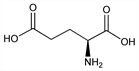
Properties
Orthorhombic, bisphenoidal crystals from aq alc. d420 vac 1.538. Melts 160° with conversion to l-pyrrolidonecarboxylic acid. Sublimes at 200°. [α]D22.4 +31.4° (6N HCl). pK1 2.19; pK2 4.25; pK3 9.67. Soly in water (g/l); 8.64 (25°); 21.86 (50°); 55.32 (75°); 140.00 (100°). Insol in methanol, ethanol, ether, acetone, cold glacial acetic acid and common neutral solvents.Derivative
Hydrochloride.Nomenclature
Properties
Orthorhombic bisphenoidal plates, dec 214°.Derivative
Sodium salt see Monosodium Glutamate.Derivative
Magnesium salt hydrobromide monohydrate.Nomenclature
Magnesium glutamate hydrobromide; magnesium bromoglutamate; Psicosoma (Ferrer); Psychoverlan (Verla).Derivative
dl-Form.Nomenclature
Properties
Orthorhombic crystals from water, 225-227° (dec). dD20 1.4601. Soly in water (g/l): 20.54 (25°); 49.34 (50°); 118.6 (75°); 284.9 (100°). Sparingly sol in alcohol, ether, petr ether.Derivative
d-Form.Nomenclature
Properties
Shiny leaflets from water. [α]D20 30.5° (c = 1.00 in 6N HCl).Therapeutic Category
Nutritional supplement. Hydrochloride as gastric acidifier. Magnesium salt hydrobromide has been used as anxiolytic.
Keywords
Replenishers/Supplements; Nutrient
Glutamic Acid Hydrochloride: Acidifier