Nomenclature
CAS number: 110-54-3
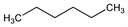
Hexane.
C
6H
14; mol wt 86.18.
C 83.62%, H 16.37%.
Description and references
Chief constituent of petr ether, ligroin, and
commercial hexane. Review of toxicity and metabolism: D. Couri,
M. Milk, Annu. Rev. Pharmacol. Toxicol. 22, 145-166 (1982). Book: Technology
and Solvents for Extracting Oilseeds and Nonpetroleum Oil, P. J. Wan, P. J. Wakelyn, Eds. (AOCS Press, Champaign, 1987) 350
pp.
Properties
Colorless, very volatile liquid; faint, peculiar
odor. d420 0.6591. bp 69°. mp 100 to 95°. nD20 1.375. Flash point:
18.0°C. Vapor pressure
(mmHg): 186.1 at 30°, 400.6 at 50°. Partition
coefficient (1-octanol/water) at 25°: >4100. Spec heat at 22.0°: 0.536
cal/g/°C. Viscosity at 15°: 0.337 cP. Heat of vaporization: 79.4
cal/g. Surface tension at 20°: 18.41 dyne/cm. Insol in water.
Miscible with alcohol, chloroform, ether. LC50 (4 hr) in mice by inhalation: 48000 ppm; LD50 orally in rats:
32.0 g/kg (Couri,
Milks).Caution
Potential symptoms of overexposure
are lightheadedness; giddiness; nausea, headache; peripheral neuropathy;
numbness of extremities, muscle weakness; irritation of eyes and nose;
dermatitis; aspiration of liquid may cause chemical pneumonia. See NIOSH Pocket Guide to Chemical
Hazards (DHHS/NIOSH 97-140, 1997) p 162.Use
Determining refractive index of minerals. Filling
for thermometers instead of mercury, usually with a blue or red dye.
Extraction solvent for oilseed processing. Organic solvent for high
performance liquid chromatography.