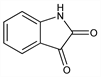
5104. Isatin
Nomenclature
Description and references
May be obtained by oxidation of indigo or of oxygenated indoles such as indoxyl, oxindole, or dioxindole: Erdmann, J. Prakt. Chem. [1] 24, 1 (1841); Laurent, ibid. 25, 430 (1842); DE 229815 in Frdl. 10, 353 (1910); JP 152932 (1942 to ICI); C.A. 44, 1544d (1950). Synthesis: Sandmeyer, Helv. Chim. Acta 2, 234 (1919); GB 128122 in C.A. 13, 2375 (1919); Marvel, Hiers, Org. Synth. coll. vol. I (2nd ed., 1941) p 327; Wibaut, Gerling, Rec. Trav. Chim. 50, 41 (1931); Neunhoeffer, Lehmann, Ber. 94, 2960 (1961); Ziegler et al., Monatsh. Chem. 94, 453 (1963). May be isolated from the urine of rabbits that are fed o-nitrophenylglyoxylic acid: Bohm, Z. Physiol. Chem. 265, 210 (1940). Pharmacology: Singh, Indian Vet. J. 48, 672 (1971). Reviews: Heller, Ueber Isatin, Isatyd, Dioxindol und Indophenin (F. Enke, Stuttgart, 1931); Sumpter, Chem. Rev. 34, 393 (1944). Discussion of chemistry of isatin: Morton, Chemistry of Heterocyclic Compounds (New York, 1946) pp 126-132.