5510. Liothyronine
Nomenclature
Description and references
One of the hormones produced by the thyroid gland that is involved in the maintenance of metabolic homeostasis. Also produced in peripheral tissues as the active metabolite of thyroxine, q.v. Identification in serum: J. Gross, R. Pitt-Rivers, Lancet I, 439 (1952). Prepn from diiodothyronine: J. Roche et al., Biochim. Biophys. Acta 11, 215 (1953). Isoln from thyroid gland and synthesis: J. Gross, R. Pitt-Rivers, Biochem. J. 53, 645 (1953). Bioactivity: eidem, ibid. 652. Elevated levels of T3 have been noted in victims of sudden infant death syndrome: G. Kocsard-Varo, Med. J. Aust. 2, 789 (1973); M. A. Chacon, J. T. Tildon, J. Pediatr. 99, 758 (1981). Direct determn in serum by RIA: I. J. Chopra et al., Thyroid 6, 255 (1996). Clinical trial in combination with thyroxine: R. Bunevicius et al., N. Engl. J. Med. 340, 424 (1999). Review of pharmacology and clinical uses: E. Sypniewski, Ann. Thorac. Surg. 56, S2-S8 (1993); of clinical trials in depression: R. Aronson et al., Arch. Gen. Psychiatry 53, 842-848 (1996); of use in heart transplantation: V. Jeevanandam, Thyroid 7, 139-145 (1997). Review of T3-receptors and molecular mechanism of action: M. A. Lazar, Endocr. Rev. 14, 184-193 (1993); G. A. Brent, N. Engl. J. Med. 331, 847-853 (1994). Review of biological effects: H. C. Freake, J. H. Oppenheimer, Annu. Rev. Nutr. 15, 263-291 (1995).
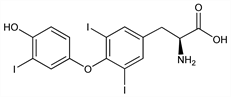
Properties
Crystals, dec 236-237°. [α]D29.5 +21.5° (c = 4.75 in a mixture of 1 part N HCl + 2 parts ethanol). Insol in water, alc, propylene glycol. Sol in dil alkalies with the formation of a brownish, water-soluble, sodium salt.Derivative
Sodium salt.Nomenclature
Derivative
Hydrochloride.Nomenclature
Properties
Long birefringent needles, dec 202-203°. [α]D29.5 +21.5° (c = 4.75 in a mixture of 1 vol N HCl and 2 vols ethanol).Therapeutic Category
Thyroid hormone.
Therapeutic Category (Veterinary)
Thyroid hormone.Keywords
Antihypothyroid; Thyroid Hormone