9415. Thyroxine
Nomenclature
Description and references
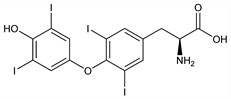
One of the thyroid hormones involved in the maintenance of metabolic homeostasis. Synthesized and stored as amino acid residues of thyroglobulin, the major protein component of the thyroid follicular colloid. Synthesis and secretion are regulated by the pituitary hormone, thyrotropin, q.v. Circulates in the serum bound to specific proteins, primarily thyroxine-binding globulin, transthyretin, and albumin. Deiodinated in peripheral tissues to the active metabolite, liothyronine, q.v. The d-form has very little activity as a thyroid hormone, but has been used to treat hyperlipidemia. Isoln from thyroid: E. C. Kendall, J. Am. Med. Assoc. 64, 2042 (1915); idem, J. Biol. Chem. 39, 125 (1919). Structure: C. R. Harington, Biochem. J. 20, 293, 300 (1926). Synthesis: C. R. Harington, G. Barger, ibid. 21, 169 (1927); of naturally occurring l-form: J. R. Chalmers et al., J. Chem. Soc. 1949, 3424; of isomers and racemate: L. G. Ginger, P. Z. Anthony, US 2889363; US 2889364 (both 1959 to Baxter Labs.). Direct determn in serum by RIA: J. C. Nelson, R. T. Tomel, Clin. Chem. 34, 1737 (1988). Comprehensive description of levothyroxine sodium: A. Post, R. J. Warren, Anal. Profiles Drug Subs. 5, 225-281 (1976). Review of pharmacology: E. Sypniewski, Ann. Thorac. Surg. 56, S2-S8 (1993); of therapeutic use: A. D. Toft, N. Engl. J. Med. 331, 174-180 (1994). Review of thyroid physiology: D. A. Fisher, Clin. Chem. 42, 135-139 (1996); R. R. Cavalieri, Thyroid 7, 177-181 (1997).
Properties
Crystals, dec 235-236°. [α]25546 3.2° (0.66 g in 6.07 g of 0.5N NaOH and 13.03 g alc); [α]D20 4.4° (3% in 0.13N NaOH in 70% EtOH).Derivative
Sodium salt.Nomenclature
Properties
Occurs as the hydrate. Triclinic crystals or cream-colored powder. Odorless, tasteless, somewhat hygroscopic. d420 2.381. [α]D20 4.4° (c = 3 in 70% ethanol). Soly in water (25°): about 15 mg/100 ml. Sol in mineral acids and in solns of alkali hydroxides and carbonates. More sol in alcohol. Very slightly sol in chloroform, ether. pH of a satd water soln: 8.35 to 9.35.Derivative
dl-Thyroxine.Nomenclature
Properties
Needle-like crystals. Dec 231-233°. Insol in water, in alcohol, and in the other usual organic solvents, but in the presence of mineral acids or alkalies it dissolves in alcohol; sol in solns of the alkali hydroxides and in hot solns of the alkali carbonates.Derivative
d-Thyroxine.Nomenclature
Properties
Crystals, dec 237°. [α]21546 +2.97° (0.74 g in 6 g of 0.5N NaOH and 14 g of alcohol).Derivative
d-Thyroxine sodium salt.Nomenclature
Therapeutic Category
Thyroid hormone. Dextrothyroxine as antilipemic.
Therapeutic Category (Veterinary)
Thyroid hormone.Keywords
Antihypothyroid; Thyroid Hormone
Dextrothyroxine: Antilipemic; Thyroid Hormones/Analogs